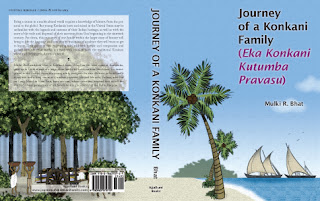
Hurray! It's here—Journey of a Konkani Family! In addition to editing the book, I wrote the about-the-book and about-the-author blurbs on the back cover, which I have reproduced here for your reading pleasure.
Book summary:
Being a citizen in a multicultural world requires a knowledge of history, from the personal to the global. But young Konkanis born and raised in the United States may be unfamiliar with the legends and customs of their Indian heritage, as well as with the story of the exile and dispersal of their ancestors from Goa beginning in the sixteenth century. For them, this true story of one family within the larger story of history will bring to life the language and community traditions of a culture they will want to get to know. Their guide in this engrossing tale, told with humor and compassion and packed with universal truths, is a man with roots in both the traditional Konkani world and the modern American world.
About the author:
Mulki Radhakrishna Bhat, a Konkani from Udupi on the west coast of Karnataka, grew up in India as part of a large, close family with rich cultural traditions. He immigrated to the United States as a young adult, navigated its very different cultural traditions, and had a long career as a nuclear physicist. He and his wife, Padma, who live on Long Island in New York, have one son, whose questions inspired him to tell the story of several generations of his family within the context of the India diaspora.
~ * ~ * ~ * ~ * ~ * ~ * ~ * ~ * ~ * ~ * ~ * ~ * ~ * ~ * ~ * ~
I am hugely grateful to my colleague Joan Pendleton, who subscribes to both the Freelance and Copyediting-L e-mail lists as I do, for referring the book's author to me when he was seeking an editor.
cultural memoir Indian diaspora author EditorMom
Saturday, March 02, 2013
Friday, March 01, 2013
Mentea (Mentee Tea)
What a lovely surprise! These exotically scented teas just arrived, along with a sweet handwritten letter, from a grateful mentee of mine. She's made my day! And my office smells delicious!
mentoring thanks tea freelancing copyeditor copyediting editor editing publishing EditorMom
Monday, February 25, 2013
Book: Journey of a Konkani Family
Several books that I have edited within the last couple of years are now being published. The latest one is Journey of a Konkani Family. If you're looking for an objective book review, you won't find it here, because I consider it an honor to have worked on the book and like it quite a bit. What you will find here, though, are reasons to pick up the book yourself.Author Mulki Radhakrishna Bhat, a Konkani from Udupi on the west coast of Karnataka, grew up in India as part of a large, close family with rich cultural traditions. He immigrated to the United States as a young adult in the 1950s, navigated its very different cultural traditions, and had a long career as a nuclear physicist. He is now retired from Brookhaven National Laboratory. He and his wife, Padma, who live on Long Island in New York, have one son, whose questions inspired him to tell the story of several generations of his family within the context of the Indian diaspora.
Mulki spent more than a decade doing research in the United States and in India, interviewing many members of his extended family, and then writing the book. And such an engrossing story it is, one that is liberally sprinkled with transliterated Sanskrit* and that explains many traditions. Here is a portion from appendix 5 about the traditions involved in naming babies:
There are elaborate rules for choosing a baby’s name that are based on the time of birth or on astrology and local customs (Kane 1974, 2:234–55; Pandey 1969, 78–85). The customs and traditions of names have changed significantly from the Vedic age to the present. Some of these are discussed in Appendix 3: “Atri Gotra, or Clan Atri.” The current orthodox [Gauda Sarasvat Brahmana] custom is to give five names: one based on the family deity, one on the month in which the baby was born, one on the baby’s asterism, a secret name, and a customary name for daily use. The secret name is known only to the parents until the age of initiation and is whispered in the baby’s ear. The secrecy is to prevent its use by any malefactor who would perform sorcery to harm the baby. Parents have to remember the secret name, which is revealed at the time of the upanayana. The custom of using twelve names at a barso is not required by codes of law and has grown to be a tradition in some families. Boys used to be named after their paternal grandfather, whether that ancestor was alive or dead. Nowadays, some of these names are considered old-fashioned and other more modern names are used. There is much greater freedom in choosing a name for a girl. Usually, girls are named after a flower, a desirable virtue, or one of the exemplary women of Hindu epics.
Having roots in both the traditional Konkani world and the modern American world, Mulki tells the humorous tale in chapter 5 of his first encounter with American football, the U.S. religion, as part of an orientation for Indian immigrants:
Ohio State University (OSU), founded in 1870 as a land-grant university, had about 20,000 students when I joined in 1956. After being admitted for the fall semester, all of the foreign students gathered in a huge hall to get a general introduction to university life. ...
Football at OSU was not just a collegiate sport; it was the religion, with all of the attendant rituals. Out of curiosity, I bought a season ticket the first year to find out what all of the fuss was about. Attendance at a couple of games left me totally unmoved. All I could make out of the action was that there were two groups of huge men who looked like gorillas in armor, and they fought for the possession of one football. Somehow all of the nuances of the game were lost on me. I decided that attending games was a waste of time, so I gave away my ticket to the first person who asked for it. The OSU Buckeyes were almost professional football players masquerading as students, according to some critics. The weekly highlight of the religious observance was the Saturday afternoon football game, in which the powerhouse Buckeyes usually annihilated any opposing team, to no one’s surprise. Every OSU victory was celebrated by the ringing of the Victory Bell (a gift of the classes of 1943, 1944, and 1954), weighing 2,420 pounds and residing 150 feet from the ground on the ramparts of the southeast tower of the OSU stadium, to announce to the faithful another triumph of good over evil. The believers claimed that on a clear day,the bell could be heard five miles away. The whole university, including all of its libraries, closed down for Saturday-afternoon home games. When a few of us requested that the university’s main library be kept open on Saturday afternoons, this “heretical depravity” caused quite a stir. The university did open the library, but this grave anomaly was not publicized. The Buckeyes’ archenemy was another football powerhouse—the University of Michigan Wolverines, at Ann Arbor, Michigan. The OSU–Michigan game, which usually ended the football season, was a drama of cosmic proportions—the ultimate battle between good and evil. Over the years, this game had acquired its own mythology, saga, and portion of the faithful. Presiding over all of these observances was the head football coach, Wayne Woodrow “Woody” Hayes (1913–1987), now of blessed memory, a cult hero elevated to the semidivine status of guru by university alumni and the residents of Columbus. For most of the alumni, these games were the most important things that ever happened to them during their university years. Any other skills or knowledge they picked up was incidental or unintentional. I learned this from a letter I got from the OSU Alumni Association Club of New York City inviting me, as an alumnus, to attend one of their collegial meetings where movies of past Buckeye victories were to be shown, and of course they would all end with the joyous ringing of the Victory Bell and the singing of the Buckeyes’ fight song. These alumni wanted to savor every moment of past football victories, once more with feeling. It was truly an amazing bit of juvenile nostalgia. Unfortunately, as a nonbeliever in all rituals, I had to pass up this happy occasion.
Beyond the tales of his own experiences, Mulki recounts and discusses how events in history affected his family and the culture of his ancestors, making it clear that people are not that different from each other, wherever they may live.
I was fortunate to work with three colleagues on Journey. Stephen Tiano handled book design and layout; Dick Margulis handled book production, publication, and marketing; and Venkatesh Krishnamoorthy proofread the book.
Journey of a Konkani Family, by Mulki R. Bhat, from Ajjalkani Books. Trade paperback (ISBN: 978-0-9835757-1-9; US$34.95); 650 pages.
_____________
*Because the license that I purchased to use the transliteration typeface does not extend to being able to use it in this blog post, I have further transliterated the Sanskrit words in the book excerpts I have quoted here, using one of the typefaces available to me through Blogger.
cultural memoir Indian diaspora author EditorMom
Monday, February 04, 2013
Book Review—What Editors Want: An Author's Guide to Scientific Journal Publishing
Since 1991, I've been editing articles written for biomedical journals. I've done it as an employee of journal publishers, as a freelance editor with journals as my clients, and as a freelance editor with authors as my clients. And since 1991, I've wished that there was a reference work that taught authors about the process of getting their writing published in journals, so that instead of my having to teach them in bits and pieces, they could find all of the information in one place.
Thank goodness, Philippa J. Benson, PhD, and Susan C. Silver, PhD, have created exactly that: What Editors Want: An Author's Guide to Scientific Journal Publishing, just out from the University of Chicago Press. It's well organized, it's comprehensive, and it's authoritative. I fervently hope that medical schools and university science programs everywhere will make it part of their curriculum. Medical and science students are taught how to do research, and often how to report it, but they generally aren't taught about the publication process and how to navigate it. That makes the process unnecessarily frustrating both for researchers and for the editors-in-chief of journals—and hey, journal staff members and freelance manuscript editors too.
Before I tell you more about the book, I must disclose a few things that you may or may not believe predispose me toward writing a favorable review:
The writing is straightforward and a pleasure to read. As an editor who works closely with a lot of authors outside the United States who are non-native speakers of English, I believe that the writing is accessible to authors with that background. I plan to highly recommend the book to all of my authors, whether they are native speakers of English or not. Benson and Silver even have a sense of humor, as evidenced by their advice in chapter 10, "Dealing with Decision Letters," about what authors should do if they receive either a rejection letter from their target journal or a decision letter from the journal noting that heavy revision of their research paper is required:
Part of what makes this book so valuable for researchers who are navigating the U.S. publishing world for the first time is that Benson and Silver have been on both sides of the author–publisher relationship. Silver said, of the process of writing the book, "On a couple of occasions, we completely failed to take our own advice about the book. ... It took us a while to ... see that there were some useful points [made by one of the manuscript's reviewers]."
There's an aspect of the book that editorial professionals like me might find surprising, though it is minor compared with the importance of the book's content: Throughout the book, the word editor is capitalized. I wondered about that style choice, so I asked the authors about it. Silver explained that the University of Chicago Press "argued with us a lot about that because it's against their style. Our point was that in this book, [editors have] a starring role. It's their wants and needs that are being discussed. They were an important character in the book." Benson added, "We wanted to build the persona of the editor, and one of the ways to do that was through capitalizing [the word editor]. We had to pick our battles carefully with Chicago. We really were very mindful about the things we pressed hard for, and this was one of them."
The book takes readers through these issues:
The authors' coverage of those issues is thorough, and I did not find myself wishing that they had dealt with additional topics. All of their advice is on target, especially for would-be authors to look at issues of their target journals before definitely deciding to submit manuscripts to those journals, to read and follow in detail the author instructions of their target journals, to educate themselves about the permissions process, and to learn how the peer-review system works.
I found only one problem with the book: The cross-references in chapters 4 ("Authorship Issues") and 5 ("Choosing the Right Journal") to sidebars 8.1, 8.2, and 8.3 from chapter 8 ("Preparing for Manuscript Submission, or 'What Editors Wish You Knew' ") are incorrect. For example, in chapter 4 the authors refer readers to the sidebar on choosing a language-polishing service, and they note that this is sidebar 8.3, but it is actually sidebar 8.1.
Benson heads the firm PJB Consulting, where she is currently working with organizations such as PLoS One and the American Society for Nutrition on author education and publishing-services projects. She is also on the faculty of the Master of Professional Studies in Publishing program at George Washington University. Silver is editor-in-chief of Frontiers in Ecology and the Environment, published by the Ecological Society of America. She has held editorial positions at Academic Press and the British Dental Association and was editor of Biologist and The Lancet Oncology.
Benson and Silver told me that they got to know each other through annual meetings of such U.S. organizations as the Council of Science Editors and the Society for Scholarly Publishing. The book grew out of workshops that they later led together in China to teach, as Silver said, "young researchers how to navigate the Western journal landscape." Silver said that some colleagues wondered why she and Benson were "going all the way to China" to teach this material, saying, "We need this stuff here." Benson said that the content of the workshop evolved each time they taught it, and it occurred to her that it would be very helpful to have a textbook to use in teaching. Benson suggested to Silver that the two of them should write that textbook, and Silver, the more cautious of the pair, eventually agreed.
The authors have impressive credentials, but they told me that they thought it would be good to have input for the book from other authoritative sources in journal publishing. The pieces that those contributors wrote became helpful sidebars scattered throughout the book. "With the exception of one person, everybody [we asked] immediately agreed" to contribute to the book, Benson said. Here are some of the sidebar authors and their topics:
The authors told me that they welcome feedback on the book because they would like to make any necessary corrections or additions to its next edition. You can write to them at whateditorswant@gmail.com. Silver added, "And if there are any additions [for the book], we can still include it in our teaching."
Without reservation, I recommend this book for those new to the publish-or-perish atmosphere of science, to those who work with science authors, and especially to those who teach them. There are already other resources available to teach researchers about good science writing, but What Editors Want is the first map that I know of through the U.S. science publication process. It's a map that no one who plays any role in science publishing should be without.
book review publishing process science publishing journals publish or perish how-to editor researcher scientist research publishing EditorMom
Thank goodness, Philippa J. Benson, PhD, and Susan C. Silver, PhD, have created exactly that: What Editors Want: An Author's Guide to Scientific Journal Publishing, just out from the University of Chicago Press. It's well organized, it's comprehensive, and it's authoritative. I fervently hope that medical schools and university science programs everywhere will make it part of their curriculum. Medical and science students are taught how to do research, and often how to report it, but they generally aren't taught about the publication process and how to navigate it. That makes the process unnecessarily frustrating both for researchers and for the editors-in-chief of journals—and hey, journal staff members and freelance manuscript editors too.
Before I tell you more about the book, I must disclose a few things that you may or may not believe predispose me toward writing a favorable review:
- The University of Chicago Press sent me a free review copy of What Editors Want, at coauthor Benson's request.
- I have a connection to Benson via Facebook. On Facebook and on Twitter, where I post a lot of publishing-related and science-related information, I have become friendly with Jennifer Kuhn, who provided administrative assistance to Benson during the process of writing the book and is now assistant managing editor for the American Society for Parenteral and Enteral Nutrition. Kuhn connected me with Benson.
- I adore the Chicago Manual of Style, published by the same press as What Editors Want, and I am guided by it for some of the book-length manuscripts that I edit.
- I am a member of the Council of Science Editors, one of the organizations through which the authors met.
- I have been invited, by one of my longtime author-clients, to travel to China at some point and teach the young researchers in his hospital department about writing for publication. I plan to use What Authors Want to guide me in teaching those researchers.
The writing is straightforward and a pleasure to read. As an editor who works closely with a lot of authors outside the United States who are non-native speakers of English, I believe that the writing is accessible to authors with that background. I plan to highly recommend the book to all of my authors, whether they are native speakers of English or not. Benson and Silver even have a sense of humor, as evidenced by their advice in chapter 10, "Dealing with Decision Letters," about what authors should do if they receive either a rejection letter from their target journal or a decision letter from the journal noting that heavy revision of their research paper is required:
As mentioned earlier, you should never allow your emotions to influence your response to a rejection letter. Usually, a little time and the immediate ingestion of chocolate or alcohol will sooth[e] the pain and you will start to see what you can do to get the manuscript back on track. Do nothing for at least twenty-four hours or until any strong emotions have subsided.
Part of what makes this book so valuable for researchers who are navigating the U.S. publishing world for the first time is that Benson and Silver have been on both sides of the author–publisher relationship. Silver said, of the process of writing the book, "On a couple of occasions, we completely failed to take our own advice about the book. ... It took us a while to ... see that there were some useful points [made by one of the manuscript's reviewers]."
There's an aspect of the book that editorial professionals like me might find surprising, though it is minor compared with the importance of the book's content: Throughout the book, the word editor is capitalized. I wondered about that style choice, so I asked the authors about it. Silver explained that the University of Chicago Press "argued with us a lot about that because it's against their style. Our point was that in this book, [editors have] a starring role. It's their wants and needs that are being discussed. They were an important character in the book." Benson added, "We wanted to build the persona of the editor, and one of the ways to do that was through capitalizing [the word editor]. We had to pick our battles carefully with Chicago. We really were very mindful about the things we pressed hard for, and this was one of them."
The book takes readers through these issues:
- Who cares what Editors want?
- Changing perspective from author to Editor
- Judging the newness of your science
- Authorship issues
- Choosing the right journal
- Understanding impact factors
- How to write a cover letter
- Preparing for manuscript submission, or "What Editors wish you knew"
- Who does what in peer review
- Dealing with decision letters
- Ethical issues in publishing
- Trends in scientific publishing
The authors' coverage of those issues is thorough, and I did not find myself wishing that they had dealt with additional topics. All of their advice is on target, especially for would-be authors to look at issues of their target journals before definitely deciding to submit manuscripts to those journals, to read and follow in detail the author instructions of their target journals, to educate themselves about the permissions process, and to learn how the peer-review system works.
I found only one problem with the book: The cross-references in chapters 4 ("Authorship Issues") and 5 ("Choosing the Right Journal") to sidebars 8.1, 8.2, and 8.3 from chapter 8 ("Preparing for Manuscript Submission, or 'What Editors Wish You Knew' ") are incorrect. For example, in chapter 4 the authors refer readers to the sidebar on choosing a language-polishing service, and they note that this is sidebar 8.3, but it is actually sidebar 8.1.
Benson heads the firm PJB Consulting, where she is currently working with organizations such as PLoS One and the American Society for Nutrition on author education and publishing-services projects. She is also on the faculty of the Master of Professional Studies in Publishing program at George Washington University. Silver is editor-in-chief of Frontiers in Ecology and the Environment, published by the Ecological Society of America. She has held editorial positions at Academic Press and the British Dental Association and was editor of Biologist and The Lancet Oncology.
Benson and Silver told me that they got to know each other through annual meetings of such U.S. organizations as the Council of Science Editors and the Society for Scholarly Publishing. The book grew out of workshops that they later led together in China to teach, as Silver said, "young researchers how to navigate the Western journal landscape." Silver said that some colleagues wondered why she and Benson were "going all the way to China" to teach this material, saying, "We need this stuff here." Benson said that the content of the workshop evolved each time they taught it, and it occurred to her that it would be very helpful to have a textbook to use in teaching. Benson suggested to Silver that the two of them should write that textbook, and Silver, the more cautious of the pair, eventually agreed.
The authors have impressive credentials, but they told me that they thought it would be good to have input for the book from other authoritative sources in journal publishing. The pieces that those contributors wrote became helpful sidebars scattered throughout the book. "With the exception of one person, everybody [we asked] immediately agreed" to contribute to the book, Benson said. Here are some of the sidebar authors and their topics:
- Carol Anne Meyer of CrossRef: "What authors need to know about CrossRef DOIs [digital object identifiers], CrossCheck, and CrossMark"
- Monica Bradford, executive editor of Science: "Honesty in authorship"
- Kepin Ma, professor at the Institute of Botany at the Chinese Academy of the Sciences: "The challenges of publishing as an international author"
- Catriona MacCallum, senior editor of PLoS Biology and consulting editor of PLoS ONE: "Choosing open access for your paper"
- Carol Edwards, publishing manager of TESOL International Association: "The permissions process"
- Lyndon Holmes, president of Aries Systems: "Online manuscript submission and peer review systems"
- Diane Sullenberger, executive editor of Proceedings of the National Academy of Sciences of the United States of America: "Ethics in scientific publishing"
- Robert M. Harington, publisher for the American Institute of Physics: "The future of publishing"
The authors told me that they welcome feedback on the book because they would like to make any necessary corrections or additions to its next edition. You can write to them at whateditorswant@gmail.com. Silver added, "And if there are any additions [for the book], we can still include it in our teaching."
Without reservation, I recommend this book for those new to the publish-or-perish atmosphere of science, to those who work with science authors, and especially to those who teach them. There are already other resources available to teach researchers about good science writing, but What Editors Want is the first map that I know of through the U.S. science publication process. It's a map that no one who plays any role in science publishing should be without.
What Editors Want: An Author's Guide to Scientific Journal Publishing, by Philippa J. Benson and Susan C. Silver, from the University of Chicago Press. Available in several formats: cloth (ISBN 978-0-226-04313-5; US$55), paperback (978-0-226-04314-2; US$20), and e-book (978-0-226-04315-9; US$7 to US$20); 192 pages.
book review publishing process science publishing journals publish or perish how-to editor researcher scientist research publishing EditorMom
Thursday, January 31, 2013
Wednesday, January 16, 2013
The Value of Twitter Chats for the Self-Employed Editorial Pro
When we have plenty of work to do, why would we freelance editorial professionals take an hour or so off to chat? Because it's vital to our success, that's why!
For a good while now, I've been participating in the monthly Twitter chats ("Twitter Freelance Fridays"), under the hashtag #EFAChat, that are hosted by the Editorial Freelancers Association (EFA), a wonderful organization I've been a member of since 1995. For one of those chats, I served as a guest expert on ergonomics. And having very recently joined the well-respected American Copy Editors Society (ACES), I took part yesterday in one of its twice-monthly chats, under the hashtag #ACESchat. For that chat, I was a guest expert, along with my colleague Ruth Thaler-Carter, on freelancing.
Because we sit (or stand) alone in our offices, we need to stay connected with our colleagues, wherever they are, so that we don't get lonely and so that we keep up with current thought in our profession. Plus, not a single one of us—newbie, mid-career professional, or veteran—knows everything there is to know about either editing or running a business, so Twitter chats offer us chances to ask questions and share advice. Chats can also make it possible to hit it off professionally with new-to-us colleagues. Those connections can become invaluable relationships that provide us with camaraderie, a shoulder to cry on, and referrals to potential clients. And finally, lurkers who follow the chats get a chance to see us talk about what we know, which just might eventually result in a referral.
If you love all things editing-related, come lurk during the next #EFAChat and the next #ACESchat. You don't have to be a member of either the EFA or ACES to participate. You just might connect with members of your tribe. You can find other Twitter chats here and here.
marketing social media Twitter Twitter chat freelance copyeditor copyediting publishing ACES EFA EditorMom
For a good while now, I've been participating in the monthly Twitter chats ("Twitter Freelance Fridays"), under the hashtag #EFAChat, that are hosted by the Editorial Freelancers Association (EFA), a wonderful organization I've been a member of since 1995. For one of those chats, I served as a guest expert on ergonomics. And having very recently joined the well-respected American Copy Editors Society (ACES), I took part yesterday in one of its twice-monthly chats, under the hashtag #ACESchat. For that chat, I was a guest expert, along with my colleague Ruth Thaler-Carter, on freelancing.
Because we sit (or stand) alone in our offices, we need to stay connected with our colleagues, wherever they are, so that we don't get lonely and so that we keep up with current thought in our profession. Plus, not a single one of us—newbie, mid-career professional, or veteran—knows everything there is to know about either editing or running a business, so Twitter chats offer us chances to ask questions and share advice. Chats can also make it possible to hit it off professionally with new-to-us colleagues. Those connections can become invaluable relationships that provide us with camaraderie, a shoulder to cry on, and referrals to potential clients. And finally, lurkers who follow the chats get a chance to see us talk about what we know, which just might eventually result in a referral.
If you love all things editing-related, come lurk during the next #EFAChat and the next #ACESchat. You don't have to be a member of either the EFA or ACES to participate. You just might connect with members of your tribe. You can find other Twitter chats here and here.
marketing social media Twitter Twitter chat freelance copyeditor copyediting publishing ACES EFA EditorMom
Friday, January 11, 2013
The 1.5-Hour Daily Social Media Schedule
First, let me say there's no universally accepted schedule for engaging properly in social media. This is my own, and by following this schedule, I spend approximately 1.5 hours on any given weekday on marketing activities, excluding e-mail. That time is spread out in bits and pieces.
Back in the olden days, I'd have spent about that much time going to the library and researching potential clients, and then coming home to type up inquiries on my typewriter to snail-mail. These days I rarely see the need to send snail mail, write prospecting e-mails, or make cold calls.
E-mail
As they arrive: Answer messages that require reply (e.g., from clients). Keep your e-mail program open during the workday but use tools to control how much time you spend on e-mail. (For example, I have set up an e-mail rule to play a certain sound when a message from any of my clients arrives, and another rule to play a different sound when my husband sends me a text message. Messages from colleagues, friends, and other people arrive unheralded by sounds so that I can ignore them until I take a work break.)
Your business web site
Each day: check that your web site loads properly and hasn’t been hacked.
Once a month: check that all outgoing links work; consider using an automated link-checking service if your site is large.
Once a month: read all site text for needed updates. (If you maintain a page or section of resources on your site, as I do, check it once a week for needed updates.)
Your blog
Post at regular intervals.
Once a day: check to make sure that it hasn't been hacked.
Your LinkedIn profile
At least once a week: update your LinkedIn status, read the digest-style e-mail about updates to your LinkedIn network, comment on some people’s status updates, and answer questions in your areas of expertise or in your LinkedIn groups.
Your Facebook profile (if you use one to market your business as I do)
Once a day or once every two days: update your status.
At least twice a week: post an interesting link to your wall with a little commentary.
At least twice a week: check your Facebook friends' or fans' statuses by clicking Home on the toolbar atop your profile. Post to their walls.
Twitter
At least twice a weekday: Tweet something.
How do I remember all this? I live and die by calendar reminders. Without them, I’d never remember to do the more infrequent tasks. The rest becomes habit after a few days or weeks of calendar reminders.
Note: I originally wrote this piece as a guest post in 2011 on another blog, one that is apparently no longer functional. I transferred it here in January 2013.
online presence social media Twitter LinkedIn Facebook freelancing marketing copyeditor copyediting editor editing EditorMom
Back in the olden days, I'd have spent about that much time going to the library and researching potential clients, and then coming home to type up inquiries on my typewriter to snail-mail. These days I rarely see the need to send snail mail, write prospecting e-mails, or make cold calls.
As they arrive: Answer messages that require reply (e.g., from clients). Keep your e-mail program open during the workday but use tools to control how much time you spend on e-mail. (For example, I have set up an e-mail rule to play a certain sound when a message from any of my clients arrives, and another rule to play a different sound when my husband sends me a text message. Messages from colleagues, friends, and other people arrive unheralded by sounds so that I can ignore them until I take a work break.)
Your business web site
Each day: check that your web site loads properly and hasn’t been hacked.
Once a month: check that all outgoing links work; consider using an automated link-checking service if your site is large.
Once a month: read all site text for needed updates. (If you maintain a page or section of resources on your site, as I do, check it once a week for needed updates.)
Your blog
Post at regular intervals.
Once a day: check to make sure that it hasn't been hacked.
Your LinkedIn profile
At least once a week: update your LinkedIn status, read the digest-style e-mail about updates to your LinkedIn network, comment on some people’s status updates, and answer questions in your areas of expertise or in your LinkedIn groups.
Your Facebook profile (if you use one to market your business as I do)
Once a day or once every two days: update your status.
At least twice a week: post an interesting link to your wall with a little commentary.
At least twice a week: check your Facebook friends' or fans' statuses by clicking Home on the toolbar atop your profile. Post to their walls.
At least twice a weekday: Tweet something.
How do I remember all this? I live and die by calendar reminders. Without them, I’d never remember to do the more infrequent tasks. The rest becomes habit after a few days or weeks of calendar reminders.
Note: I originally wrote this piece as a guest post in 2011 on another blog, one that is apparently no longer functional. I transferred it here in January 2013.
online presence social media Twitter LinkedIn Facebook freelancing marketing copyeditor copyediting editor editing EditorMom
Thursday, January 10, 2013
Book Review—Copyright and Permissions: What Every Writer and Editor Should Know
We editorial pros have all encountered manuscripts with quotations in them that led us to wonder about the limits of fair use. But where do we go for more information on this issue? Copyright and Permissions: What Every Writer and Editor Should Know, a new booklet just out from the Editorial Freelancers Association, is just what we've all been looking for.
Before I go further in this review, I must disclose this information: I have been friends with Elsa Peterson, the book's author, for years. And when she was employed by McGraw-Hill Higher Education as a developmental editor, I edited some manuscripts for her in my role as a freelancer.
But though Elsa is my friend, I can also tell you that she knows permissions quite well. She has more than 20 years' experience as a permissions editor, time spent hunting down the true owners of copyright and helping her clients negotiate the wording of credit lines and fees for the right to reproduce previously published illustrations and tables and such. She knows where to look, whom to ask, and—most important—how to ask for permission to reprint. So I have no trouble believing that Elsa knows what she's talking about when it comes to permissions.
This booklet is quite handy for freelancers who don't have a publishing house's legal department to back them up, and the writing is friendly, straightforward, and accessible. Will using the book replace getting advice from a lawyer? No, but it will point readers in the right direction. It covers
I've been working in publishing for 29 years now, so the need to obtain permission for reusing material isn't new to me, but there are details I sometimes forget. Elsa's book makes it easy to find what I need to remember. I especially like these features of the book:
Copyright and Permissions (ISBN: 978-1-880407-23-3) is available as a download (US$8.25) and in traditional printed form (US$12.25; 48 pages). I don't think any editorial professional can afford to be without it.
book review copyright estimate permissions fair use copyeditor copyediting editor editing publishing EditorMom
Before I go further in this review, I must disclose this information: I have been friends with Elsa Peterson, the book's author, for years. And when she was employed by McGraw-Hill Higher Education as a developmental editor, I edited some manuscripts for her in my role as a freelancer.
But though Elsa is my friend, I can also tell you that she knows permissions quite well. She has more than 20 years' experience as a permissions editor, time spent hunting down the true owners of copyright and helping her clients negotiate the wording of credit lines and fees for the right to reproduce previously published illustrations and tables and such. She knows where to look, whom to ask, and—most important—how to ask for permission to reprint. So I have no trouble believing that Elsa knows what she's talking about when it comes to permissions.
This booklet is quite handy for freelancers who don't have a publishing house's legal department to back them up, and the writing is friendly, straightforward, and accessible. Will using the book replace getting advice from a lawyer? No, but it will point readers in the right direction. It covers
- Whether it's necessary to obtain permission to use the material
- Where and how to request permission
- What to do if the copyright holder doesn't grant permission for reuse or requests a high fee for granting it
- The basics of copyright, public domain, and fair use
- Current issues concerning copyright
- How permissions editing is done, step by step
I've been working in publishing for 29 years now, so the need to obtain permission for reusing material isn't new to me, but there are details I sometimes forget. Elsa's book makes it easy to find what I need to remember. I especially like these features of the book:
- "Copyright Facts and Fallacies," where common misperceptions are debunked
- Step-by-step lists of procedures that should be followed to get the best results
- The table outlining duration of copyright protection (This is definitely one I'll bookmark.)
- Discussion of where copyright issues are heading
- The table of information fields for a permissions database
- The sample permissions request letter
Copyright and Permissions (ISBN: 978-1-880407-23-3) is available as a download (US$8.25) and in traditional printed form (US$12.25; 48 pages). I don't think any editorial professional can afford to be without it.
book review copyright estimate permissions fair use copyeditor copyediting editor editing publishing EditorMom
Monday, January 07, 2013
Book: A Dream of Daring
![]() |
| Cover for A Dream of Daring |
Because I edited the book, I can't give an unbiased review here. But because I love the book, I want to tell you all about it. Here is the apt description of the book from its back cover:
Tom Edmunton, the science-minded son of a cotton planter, has designed the precursor of the tractor in antebellum Louisiana. He foresees a new age of mechanized farming that will empty the fields of men and supplant the South’s peculiar institution. But the planters of his town don’t like his big ideas about changing their world or the intensity with which he’s pursuing them. Tensions peak when the tractor is stolen, and in the process, someone dear to the inventor is murdered.
Set at a crossroads of history when an old era is about to tumble and a new one ready to gain ground, the story centers on the clash between the men vying to take hold of the future—the men who seek to employ the power of science and industry to transform the world—and those who seek to maintain their grip on another kind of power upon which they built their lives and fortunes.
As Tom hears the call of the new age, he also feels the pull of two women—one at the top of society’s ladder and the other at the bottom. Rachel, a senator’s daughter, is the beautiful Southern belle who loves him, but will she break with her family to stand by his side when the town shuns him? Solo is the unbridled grassland filly, the feisty mulatto slave who despises Tom, along with every other man from the race that binds her. Rachel is free, but is her spirit chained? Solo is chained, but is her spirit free?
This is a haunting tale of the Old South, with its sweeping fields of white-gold cotton, its majestic plantations, its elegant gentry, and its embattled slaves. But the story also poses urgent questions for our own imperiled world as it delves into the souls of those who want to harness nature and those who want to harness other men. Which camp is on the rise today? Will it save us or destroy us?
Set at a crossroads of history when an old era is about to tumble and a new one ready to gain ground, the story centers on the clash between the men vying to take hold of the future—the men who seek to employ the power of science and industry to transform the world—and those who seek to maintain their grip on another kind of power upon which they built their lives and fortunes.
As Tom hears the call of the new age, he also feels the pull of two women—one at the top of society’s ladder and the other at the bottom. Rachel, a senator’s daughter, is the beautiful Southern belle who loves him, but will she break with her family to stand by his side when the town shuns him? Solo is the unbridled grassland filly, the feisty mulatto slave who despises Tom, along with every other man from the race that binds her. Rachel is free, but is her spirit chained? Solo is chained, but is her spirit free?
This is a haunting tale of the Old South, with its sweeping fields of white-gold cotton, its majestic plantations, its elegant gentry, and its embattled slaves. But the story also poses urgent questions for our own imperiled world as it delves into the souls of those who want to harness nature and those who want to harness other men. Which camp is on the rise today? Will it save us or destroy us?
Gen did impressively detailed research for the book. I couldn't find anything that was off kilter in the story. But beyond that, the book is an engrossing read. I edited late many nights simply because I didn't want to stop reading. I couldn't wait to find out what would happen next.
The book's official publication date is February 12. It will be available in paperback (283 pages; 6″ × 9″) and as a Kindle e-book from Amazon. The ISBN for the paperback is 978-097445796-3; the ASIN for the Kindle version is B00B1HPMZY. Gen tells me that her novel made the cut for a Booklist review and recommendation in its January issue.
If you participate in Goodreads or LibraryThing (or want to register at no charge), you'll want to know that Gen is giving away 25 paperback copies at each site. The contest to win them is open until January 12, so don't wait to enter.
And if you end up buying and reading A Dream of Daring, please tell Gen that I sent you, and check out her first novel, which I also edited and loved: Noble Vision, a medical thriller.
historical novel Old South Civil War author Goodreads LibraryThing EditorMom
Saturday, January 05, 2013
How to Be Memorable to Clients and Colleagues
In 2011, I wrote about how well it works for me to send "Happy New Year" greeting cards each year to my clients. The cards remind my clients that they've enjoyed working with me in the past and often make them think about sending more assignments my way.
It's all the better if the cards that you send to your clients and colleagues are memorable. I recently received a great New Year's postcard from Paula Gordon, a translator and editor who is a colleague of mine from the Editorial Freelancers Association and who subscribes to some of the same profession-related e-mail lists that I do. It's a gorgeous collage created by Paula's sister Zelda Leah Gatuskin, and it carries the caption "Wishing You Continued Strength and Wisdom." Zelda created the collage in 1994 for her book Ancestral Notes.
I like the postcard so much for several reasons:
The card is memorable enough that I have propped it up on my desk, beside my computer monitor, to cheer me up on those occasional days when I need extra strength and wisdom. I told Paula that, and she replied:
If we solopreneurs follow Paula's example in choosing and/or creating greeting cards and postcards, our clients will remember us when they need our services and our colleagues will think of us when they need to refer clients to fellow professionals.
See this page, this page, this page, and this page for more of Zelda's fascinating collages, along with the stories they illustrate.
marketing clients colleagues referrals greeting cards freelancing copyeditor copyediting editor editing publishing EditorMom
It's all the better if the cards that you send to your clients and colleagues are memorable. I recently received a great New Year's postcard from Paula Gordon, a translator and editor who is a colleague of mine from the Editorial Freelancers Association and who subscribes to some of the same profession-related e-mail lists that I do. It's a gorgeous collage created by Paula's sister Zelda Leah Gatuskin, and it carries the caption "Wishing You Continued Strength and Wisdom." Zelda created the collage in 1994 for her book Ancestral Notes.
I like the postcard so much for several reasons:
- It's a lot more fun than the bland cards that office-supply stores sell to business owners.
- It doesn't focus on any religious holiday themes and so won't be offensive to anyone.
- Who wouldn't want continued strength and wisdom?
I used an already published collage, and worked with Zelda to turn it into a postcard with a captioned image. She prepared the file for printing and consulted on the text and layout of the reverse side. (I wanted less space so I wouldn't feel like I had to write a lot—that's my obstacle to sending cards—but she convinced me to leave a little more room.) I also like that I had it printed locally by an independent print shop. All in all, it was a fun and satisfying project.
The card is memorable enough that I have propped it up on my desk, beside my computer monitor, to cheer me up on those occasional days when I need extra strength and wisdom. I told Paula that, and she replied:
I was shooting for something that people would be happy to pin on their bulletin boards and not toss away at the end of the season. I find the image inspiring, and apt for my circle of editor, translator, and writer friends and colleagues.
If we solopreneurs follow Paula's example in choosing and/or creating greeting cards and postcards, our clients will remember us when they need our services and our colleagues will think of us when they need to refer clients to fellow professionals.
See this page, this page, this page, and this page for more of Zelda's fascinating collages, along with the stories they illustrate.
marketing clients colleagues referrals greeting cards freelancing copyeditor copyediting editor editing publishing EditorMom
Tuesday, January 01, 2013
Start the New Year Out Right: Update Your Online Information
If you're self-employed, it's time to double-check that online information about you is up to date:
online presence social media Twitter LinkedIn Facebook freelancing marketing copyeditor copyediting editor editing EditorMom
- Check copyright years for all of the online venues you control. For example, the bottom of every page of my business website carries this line:
© 1984–2013 KOK Edit | All rights reserved. | 631-997-8191
The code is set to update the final year of that range on January 1 of each new year, so I no longer have to worry about it. Before that automation was in place, I had to go behind the scenes and update the year manually. The "About Me" sidebar on this blog also carries a copyright line; I must update it manually every year.
- Review your résumé or curriculum vitae and ensure that it is up to date. If you update it, make sure that you upload the updated version to all online directories where you are listed.
- Check all online directories and "About" pages where information about you is listed and make sure that all details are current. Be sure to include your Facebook, LinkedIn, and Twitter profiles. For example, the first line in the "About Me" sidebar on this blog at one point read: "I've been in publishing 29 years, the last 18 self-employed." Until I revamped that paragraph, I had to update those two numbers every year.
- Check that all online photographs of you—ones that you uploaded yourself—are current.
- Back up all of your social media profiles and your blog.
- Check that your snail-mail address, phone and fax numbers, email address, and website address are current wherever you have posted them online.
online presence social media Twitter LinkedIn Facebook freelancing marketing copyeditor copyediting editor editing EditorMom
Monday, November 26, 2012
Fixing the "Editing Tools" Page of the Copyeditors' Knowledge Base
Argh and double argh!
It seems that 12 days ago, I unknowingly mangled the "Editing Tools" page of the Copyeditors' Knowledge Base (CKB). I've now restored the page the best that I could, but some entries that were once on that page may not be there now. If those of you who love and use the CKB gleaned some links from the "Editing Tools" page that you don't see there now, I would be fawningly grateful if you would e-mail those links to me at editor@kokedit.com.
Here's the technical explanation of how this mess occurred:
Whenever I add links to any page in the CKB, I do so within the page's PHP file online, via the file-editing interface of my web host. Then I always immediately close out the web-host interface and FTP into my web site's files via CuteFTP to back up any changed files onto my computer.
I've figured out what I must have done to mess things up with the "Editing Tools" page: While editing the file online, I went to a spot about halfway down the page, selected what I intended to be only a few lines, and deleted them. But apparently, I did not realize at the time that I selected the entire final half (!) of the code and text—not just a few lines—from the file before I saved it. So of course when I backed up the newly saved file onto my computer, what I backed up was the page that was now missing its bottom half.
Because I'm very strict with myself about backing up my web-site files onto my computer immediately after editing them, I did not have the earlier version on my computer to upload online. (In other words, the backup file that was on my computer was missing its bottom half, just like the "Editing Tools" page on my web site). I did, however, have a version of the page from 2011 when my web site was in HTML instead of PHP. So I copied the bottom half of the code and text from the old SHTML file and pasted it into the current PHP file, and then made adjustments where needed.
copyeditor copyediting editor editing publishing Copyeditors' Knowledge Base EditorMom
It seems that 12 days ago, I unknowingly mangled the "Editing Tools" page of the Copyeditors' Knowledge Base (CKB). I've now restored the page the best that I could, but some entries that were once on that page may not be there now. If those of you who love and use the CKB gleaned some links from the "Editing Tools" page that you don't see there now, I would be fawningly grateful if you would e-mail those links to me at editor@kokedit.com.
Here's the technical explanation of how this mess occurred:
Whenever I add links to any page in the CKB, I do so within the page's PHP file online, via the file-editing interface of my web host. Then I always immediately close out the web-host interface and FTP into my web site's files via CuteFTP to back up any changed files onto my computer.
I've figured out what I must have done to mess things up with the "Editing Tools" page: While editing the file online, I went to a spot about halfway down the page, selected what I intended to be only a few lines, and deleted them. But apparently, I did not realize at the time that I selected the entire final half (!) of the code and text—not just a few lines—from the file before I saved it. So of course when I backed up the newly saved file onto my computer, what I backed up was the page that was now missing its bottom half.
Because I'm very strict with myself about backing up my web-site files onto my computer immediately after editing them, I did not have the earlier version on my computer to upload online. (In other words, the backup file that was on my computer was missing its bottom half, just like the "Editing Tools" page on my web site). I did, however, have a version of the page from 2011 when my web site was in HTML instead of PHP. So I copied the bottom half of the code and text from the old SHTML file and pasted it into the current PHP file, and then made adjustments where needed.
copyeditor copyediting editor editing publishing Copyeditors' Knowledge Base EditorMom
Wednesday, November 07, 2012
Aerobic Editing
I've written about the benefits of working at a sit–stand or standing desk. Now here's evidence that I dance while I'm standing at work, and that editing can indeed be aerobic. Silly you—you thought editing was a sedentary task. If you like disco, crank up your speakers while you watch the video clip. Why, yes, I am a middle-aged geezer.
sit–stand desk standing desk health obesity weight loss ergonomics EditorMom
Monday, October 22, 2012
When Opportunity Knocks
As an editor, you don't always know exactly what your authors think of you. On the few occasions that they make quite clear their view of you and your work, take such revelations as the gifts that they are and relish them.
I work with a lot of physician–researchers from around the world for whom remaining competitive in their profession means that they must always be working to get their research published in English-language medical journals. In addition to doing ESL (English as a second language) or EFL (English as a foreign language) editing for them, I always take special care with these authors to treat them with great respect, because not only do they have to be proficient in medicine and research but they also must deal with the sometimes frustrating US peer review and publication system. In addition, they must do all of that in English, which is their second or third language. I can't help but admire their perseverance a great deal.
One of my longtime authors is Yixin Zhou, MD, PhD, whose journal articles on orthopedic surgery I've been editing since 2005. He is the chairman of the Department of Adult Joint Reconstructive Surgery of Beijing Jishuitan Hospital, where the number of joint-replacement procedures performed increases annually by 20% to 30%. I will soon start editing number 15 in the steady march of articles I have polished for him. He tells me that my name is well known at his hospital; it is common knowledge, he says, that when I edit a manuscript for any surgeon, it usually gets published.
Being told that, after having corresponded with him by e-mail for years, was wonderful enough. But recently, Yixin e-mailed me to say that he was traveling to New York City for a medical conference and would like to meet with me. So on Saturday, October 20, I took a 1.5-hour ride on the Long Island Rail Road to Penn Station and then walked just over 1 mile to the Sheraton Hotel at 52nd Street and 7th Avenue, where Yixin and his colleagues were staying.
I was prepared to show Yixin and his colleagues my great respect for them by saying a few phrases in Mandarin. My colleague Jim Jones, a technical editor and Chinese-to-English translator, created an mp3 file for me so that I could listen to him saying the phrases and could then practice them. But once Yixin and I were talking, I remembered only to say, "Ni hao" ("hello"). He told me that my Chinese was good. But I know he was just being kind.
Yixin and I had drinks at the hotel's restaurant and chatted about the paths each of us had taken to get where we are in our respective professions. He had planned for us to have dinner with several of the younger surgeons in his department whom he is training, but they got stuck in Manhattan traffic. So Yixin and I went on to a nearby seafood restaurant, where we dined with several others who were in town for the same medical conference. One of them is a surgeon at another hospital (not Yixin's hospital), and three are sales representatives for Zimmer, a major supplier of orthopedic prosthetics (for the hip, shoulder, and knee) for surgeons around the world. They were all quite interested to hear that I am Yixin's editor, and he told me that he was telling them all about what good care I take of him and his manuscripts.
Yixin knows how much I love Chinese and Japanese whole-leaf teas, so during our meeting he presented me with a magnificently packaged gift of Chinese pi lo chun green tea, sometimes called biluochun. According to the one English sentence that appears amidst the Chinese characters on each wrapper, the tea will "pick you up, help you lose weight, break down cholesterin, as well as benefit those with blood pressure and heart problems." This is in line with what Yixin said to me when we were making our farewells later, at the end of the evening: "Please take good care of yourself, because you are important to us. Smile often, eat good food, and take care of your health."
But the highlight of the evening was this: Because the Chinese government is throwing money at its researchers, there is a big push for every specialist physician to do research and get it published in English-language journals. Yixin is training his younger colleagues in scientific writing, but he wants to pay my way to Beijing sometime within the next year so that I can teach them, working with the aid of an interpreter. Many of my international authors live in Asia, so it has long been my dream to meet them in person and talk with them.
But even in my most creative dreams, I never pictured myself traveling to Asia to teach physician–researchers! So even though I am an introvert and a homebody, I will take this once-in-a-lifetime opportunity if it does indeed finally present itself. Why? Because, as it says on the "About" page of my business web site,
The most obvious benefit of Yixin's plan is that will I get to teach young researchers how to write for an English-language audience, which means that they will be able to communicate to a much wider group of readers the scientific advances they make, thus potentially helping many more patients around the world. But the best benefit, one that is quite humbling, is that I will have the chance to learn by immersion about another culture, one that I greatly admire. I hope that how I work with those researchers will, at least in a very small way, enhance Chinese–American communication, to make the world a friendlier place.
As events take place to make the possibility of my teaching in Beijing a reality, I will keep everyone posted through this blog.
clients relationships goodwill travel freelancing copyeditor copyediting editor editing publishing EditorMom
I work with a lot of physician–researchers from around the world for whom remaining competitive in their profession means that they must always be working to get their research published in English-language medical journals. In addition to doing ESL (English as a second language) or EFL (English as a foreign language) editing for them, I always take special care with these authors to treat them with great respect, because not only do they have to be proficient in medicine and research but they also must deal with the sometimes frustrating US peer review and publication system. In addition, they must do all of that in English, which is their second or third language. I can't help but admire their perseverance a great deal.
![]() |
| Yixin Zhou, MD, PhD |
Being told that, after having corresponded with him by e-mail for years, was wonderful enough. But recently, Yixin e-mailed me to say that he was traveling to New York City for a medical conference and would like to meet with me. So on Saturday, October 20, I took a 1.5-hour ride on the Long Island Rail Road to Penn Station and then walked just over 1 mile to the Sheraton Hotel at 52nd Street and 7th Avenue, where Yixin and his colleagues were staying.
I was prepared to show Yixin and his colleagues my great respect for them by saying a few phrases in Mandarin. My colleague Jim Jones, a technical editor and Chinese-to-English translator, created an mp3 file for me so that I could listen to him saying the phrases and could then practice them. But once Yixin and I were talking, I remembered only to say, "Ni hao" ("hello"). He told me that my Chinese was good. But I know he was just being kind.
![]() |
| A gift of tea |
Yixin knows how much I love Chinese and Japanese whole-leaf teas, so during our meeting he presented me with a magnificently packaged gift of Chinese pi lo chun green tea, sometimes called biluochun. According to the one English sentence that appears amidst the Chinese characters on each wrapper, the tea will "pick you up, help you lose weight, break down cholesterin, as well as benefit those with blood pressure and heart problems." This is in line with what Yixin said to me when we were making our farewells later, at the end of the evening: "Please take good care of yourself, because you are important to us. Smile often, eat good food, and take care of your health."
But the highlight of the evening was this: Because the Chinese government is throwing money at its researchers, there is a big push for every specialist physician to do research and get it published in English-language journals. Yixin is training his younger colleagues in scientific writing, but he wants to pay my way to Beijing sometime within the next year so that I can teach them, working with the aid of an interpreter. Many of my international authors live in Asia, so it has long been my dream to meet them in person and talk with them.
But even in my most creative dreams, I never pictured myself traveling to Asia to teach physician–researchers! So even though I am an introvert and a homebody, I will take this once-in-a-lifetime opportunity if it does indeed finally present itself. Why? Because, as it says on the "About" page of my business web site,
It is enormously satisfying to help authors who are non-native English speakers communicate their research to their peers worldwide. I like to believe that what I do makes at least a small difference in the world in two ways:
It is a privilege to be entrusted with polishing an author's work, one for which I am always deeply grateful. I can often be found drinking a cup of tea brewed using fresh tea leaves from China, Japan, Taiwan, or India in honor of my authors' publishing successes.
- Helping physicians communicate research that will enable other physicians to treat their patients more effectively
- Increasing cross-cultural cooperation and communication one pair of people (an author and me) at a time
It is a privilege to be entrusted with polishing an author's work, one for which I am always deeply grateful. I can often be found drinking a cup of tea brewed using fresh tea leaves from China, Japan, Taiwan, or India in honor of my authors' publishing successes.
The most obvious benefit of Yixin's plan is that will I get to teach young researchers how to write for an English-language audience, which means that they will be able to communicate to a much wider group of readers the scientific advances they make, thus potentially helping many more patients around the world. But the best benefit, one that is quite humbling, is that I will have the chance to learn by immersion about another culture, one that I greatly admire. I hope that how I work with those researchers will, at least in a very small way, enhance Chinese–American communication, to make the world a friendlier place.
As events take place to make the possibility of my teaching in Beijing a reality, I will keep everyone posted through this blog.
clients relationships goodwill travel freelancing copyeditor copyediting editor editing publishing EditorMom
Friday, September 14, 2012
Updated Resources for Writing and Editing Grant Proposals
Thanks to information from Paula Gordon, fellow member of the Editorial Freelancers Association, I've updated this 2011 blog post of mine: "Resources for Writing and Editing Grant Proposals."
grants grant proposal science funding copyeditor copyediting editor editing writer writing EditorMom
Tuesday, September 11, 2012
Tools for Finding and Attracting Clients
In this economic recession and electronically connected world, self-employed editorial pros can't depend on just the old ways—making cold calls and sending prospecting packets out by snail mail—to get clients. It's wiser, for your bottom line, to use a variety of methods. These are the tools that I find to be good for discovering and attracting clients, listed in descending order by my sense of how many client inquiries come through each one:
I've been self-employed nearly 18 years now and am quite good at hunting for and attracting new clients in a variety of ways. I haven't had a day without a work project in years. If you're a self-employed editorial pro and would like to learn more about how to use the social media Big 3—Twitter, LinkedIn, Facebook—to find prospective clients and to attract them, sign up for my 90-minute November 1 webinar.
online presence social media Twitter LinkedIn Facebook freelancing marketing webinar copyeditor copyediting editor editing EditorMom
- Word of mouth (which means publishing contacts recommending my editing services to others in publishing, and authors recommending my services to their colleagues)
- Participation in profession-related e-mail lists (check out some of the ones listed here)
- My business web site
- My listing in the freelance directory of the American Medical Writers Association (tie with item 5)
- My ad on the web site of the Council of Science Editors (tie with item 4)
- My presence on Twitter
- My listing in the member directory of the Editorial Freelancers Association
- My presence on LinkedIn
- My presence on Facebook
- My listing in the directory of the Board of Editors in the Life Sciences
- My listing in the Directory of CE-L Freelancers of the Copyediting-L e-mail list (see the "Freelancers" tab)
online presence social media Twitter LinkedIn Facebook freelancing marketing webinar copyeditor copyediting editor editing EditorMom
Tuesday, August 21, 2012
Doesn't All Editing Cost the Same?
Doesn't all editing cost the same? Spoiler: No.
This is why an editor's total fee differs among projects. In a corner of my office, on the wall, I have these editing speeds (number of 250-word manuscript pages per hour) posted from years ago when I worked on a lot of fiction manuscripts for mass-market paperbacks*:
The bulk of the editing I do today is of manuscripts for biomedical journals, written by non-native speakers of English. My general editing speed for those:
And of course each editor's speed is different, and a lot depends on how much work the manuscript needs, whatever the genre.
___________________
*Printed dimensions: usually 6.75" × 4.25".
fees cost estimate clients freelancing copyeditor copyediting editor editing publishing EditorMom
This is why an editor's total fee differs among projects. In a corner of my office, on the wall, I have these editing speeds (number of 250-word manuscript pages per hour) posted from years ago when I worked on a lot of fiction manuscripts for mass-market paperbacks*:
Really messy mss.: 9 pp./h
Average mss.: 12–17 pp./h
Easy juvenile mss.: 19 pp./h
Average mss.: 12–17 pp./h
Easy juvenile mss.: 19 pp./h
The bulk of the editing I do today is of manuscripts for biomedical journals, written by non-native speakers of English. My general editing speed for those:
2 pp./h
And of course each editor's speed is different, and a lot depends on how much work the manuscript needs, whatever the genre.
___________________
*Printed dimensions: usually 6.75" × 4.25".
fees cost estimate clients freelancing copyeditor copyediting editor editing publishing EditorMom
Friday, August 17, 2012
At the End of a Project
Today I sent my final invoice for the cultural memoir that I've spent a long time editing. The author, a highly intelligent man whom I respect a great deal, sent me this wonderful e-mail just now:
authors thanks gratitude copyeditor copyediting editor editing EditorMom
Thank you very much for your skillful and excellent editing of [book title]. Because of all the hard work put in by you, [it] is a much better book with smooth-flowing text that tells its story well. It has been a pleasure working with you, and thanks again for your collaboration. Please keep in touch, and I am looking forward to presenting you a copy of [the book] in person soon.
authors thanks gratitude copyeditor copyediting editor editing EditorMom
Wednesday, August 15, 2012
Video "What Is Substantive Editing?"
Sometimes you'll hear me talk about doing substantive editing, which is the type of editing I do all the time, both for native and non-native speakers of English. But what is it? In this video, the editor-in-chief of the journal Academic Medicine discusses substantive editing with the journal's director of staff editing. If you're an author, the video will help you understand more about what substantive editing is. If you're an editor, you might want to share the link to the video with your authors.
copyeditor copyediting editor editing substantive editing publishing EditorMom
Wednesday, August 08, 2012
What "Thank You" Means to Freelancers and Mentors
Two little words can make a huge difference in my outlook—and in yours too, I'm sure: Thank you.
Those two words can motivate me to work harder, share more with colleagues, and be kinder to everyone around me. Do they affect you the same way?
Today I received the following e-mail from a colleague, and it inspired me:
Thank-yous are especially important for the self-employed. We usually work alone, not in offices where we can hear such motivating words in person. Yes, we get paid to do what we do, but appreciation is rewarding too.
Thank-yous are also important to mentors. We help others because we enjoy doing so. But when we are thanked, we feel honored and moved to give even more.
Have you thanked a freelancer or a mentor today?
thanks gratitude mentor freelancer EditorMom
Those two words can motivate me to work harder, share more with colleagues, and be kinder to everyone around me. Do they affect you the same way?
Today I received the following e-mail from a colleague, and it inspired me:
Katharine,
I am a lurker on the X and Y [e-mail] lists and I just wanted to let you know that I am always appreciative of your interesting/informative posts to both forums! I have also learned a lot from browsing around your website and reading many of the excellent things you've posted there.
I have been doing part-time freelance work (copyediting and proofreading) since [year redacted]. . . . My day job . . . has been drastically cut back for the coming year and I'm looking at this as an opportunity to grow my freelance business. I really do believe I can be successful in this new endeavor, and a large part of my optimism is fueled by the sense of purpose and professionalism that I've passively cyber-gleaned . . . from more seasoned folks like you!
I'm sure you get feedback and kudos from your clients as well as from colleagues whom you've helped on specific matters. But I just wanted to let you know that there is at least one member of your "silent fan club" who is no less appreciative of your openness and sharing!
I am a lurker on the X and Y [e-mail] lists and I just wanted to let you know that I am always appreciative of your interesting/informative posts to both forums! I have also learned a lot from browsing around your website and reading many of the excellent things you've posted there.
I have been doing part-time freelance work (copyediting and proofreading) since [year redacted]. . . . My day job . . . has been drastically cut back for the coming year and I'm looking at this as an opportunity to grow my freelance business. I really do believe I can be successful in this new endeavor, and a large part of my optimism is fueled by the sense of purpose and professionalism that I've passively cyber-gleaned . . . from more seasoned folks like you!
I'm sure you get feedback and kudos from your clients as well as from colleagues whom you've helped on specific matters. But I just wanted to let you know that there is at least one member of your "silent fan club" who is no less appreciative of your openness and sharing!
Thank-yous are especially important for the self-employed. We usually work alone, not in offices where we can hear such motivating words in person. Yes, we get paid to do what we do, but appreciation is rewarding too.
Thank-yous are also important to mentors. We help others because we enjoy doing so. But when we are thanked, we feel honored and moved to give even more.
Have you thanked a freelancer or a mentor today?
thanks gratitude mentor freelancer EditorMom
Subscribe to:
Posts (Atom)