KOK Edit: Your favorite copyeditor since 1984(SM)
KOK Edit: your favorite copyeditor since 1984(SM) KOK Edit: your favorite copyeditor since 1984(SM) Katharine O'Moore Klopf
Blog

Wednesday, December 14, 2005

Spying on War Protesters

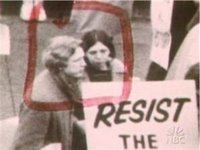
The Pentagon is watching you (photo from NBC Nightly News).I've long thought that under the Bush administration, the government keeps a close watch on war protesters. Now NBC News has accessed a Pentagon database that proves it:


A year ago, at a Quaker Meeting House in Lake Worth, Fla., a small group of activists met to plan a protest of military recruiting at local high schools. What they didn't know was that their meeting had come to the attention of the U.S. military.

A secret 400-page Defense Department document obtained by NBC News lists the Lake Worth meeting as a “threat” and one of more than 1,500 “suspicious incidents” across the country over a recent 10-month period.

“This peaceful, educationally oriented group being a threat is incredible,” says Evy Grachow, a member of the Florida group called The Truth Project. ...

The Defense Department document is the first inside look at how the U.S. military has stepped up intelligence collection inside this country since 9/11, which now includes the monitoring of peaceful anti-war and counter-military recruitment groups.

“I think Americans should be concerned that the military, in fact, has reached too far,” says NBC News military analyst Bill Arkin.


Four dozen anti-war meetings
The DOD database obtained by NBC News includes nearly four dozen anti-war meetings or protests, including some that have taken place far from any military installation, post or recruitment center. One “incident” included in the database is a large anti-war protest at Hollywood and Vine in Los Angeles last March that included effigies of President Bush and anti-war protest banners. Another incident mentions a planned protest against military recruiters last December in Boston and a planned protest last April at McDonald’s National Salute to America’s Heroes—a military air and sea show in Fort Lauderdale, Fla.


The Fort Lauderdale protest was deemed not to be a credible threat and a column in the database concludes: “US group exercising constitutional rights.” Two-hundred and forty-three other incidents in the database were discounted because they had no connection to the Department of Defense—yet they all remained in the database.

The DOD has strict guidelines (.PDF link), adopted in December 1982, that limit the extent to which they can collect and retain information on U.S. citizens.

Still, the DOD database includes at least 20 references to U.S. citizens or U.S. persons. Other documents obtained by NBC News show that the Defense Department is clearly increasing its domestic monitoring activities. One DOD briefing document stamped “secret” concludes: “[W]e have noted increased communication and encouragement between protest groups using the [I]nternet,” but no “significant connection” between incidents, such as “reoccurring instigators at protests” or “vehicle descriptions.”

The increased monitoring disturbs some military observers.

“It means that they’re actually collecting information about who’s at those protests, the descriptions of vehicles at those protests,” says Arkin. “On the domestic level, this is unprecedented,” he says. “I think it's the beginning of enormous problems and enormous mischief for the military.”

Some former senior DOD intelligence officials share his concern. George Lotz, a 30-year career DOD official and former U.S. Air Force colonel, held the post of Assistant to the Secretary of Defense for Intelligence Oversight from 1998 until his retirement last May. Lotz, who recently began a consulting business to help train and educate intelligence agencies and improve oversight of their collection process, believes some of the information the DOD has been collecting is not justified.


Make sure they are not just going crazy
“Somebody needs to be monitoring to make sure they are just not going crazy and reporting things on U.S. citizens without any kind of reasoning or rationale,” says Lotz. “I demonstrated with Martin Luther King in 1963 in Washington,” he says, “and I certainly didn’t want anybody putting my name on any kind of list. I wasn’t any threat to the government,” he adds.


The military’s penchant for collecting domestic intelligence is disturbing—but familiar—to Christopher Pyle, a former Army intelligence officer.

“Some people never learn,” he says. During the Vietnam War, Pyle blew the whistle on the Defense Department for monitoring and infiltrating anti-war and civil rights protests when he published an article in the Washington Monthly in January 1970.

The public was outraged and a lengthy congressional investigation followed that revealed that the military had conducted investigations on at least 100,000 American citizens. Pyle got more than 100 military agents to testify that they had been ordered to spy on U.S. citizens—many of them anti-war protestors and civil rights advocates. In the wake of the investigations, Pyle helped Congress write a law placing new limits on military spying inside the U.S.

But Pyle, now a professor at Mt. Holyoke College in Massachusetts, says some of the information in the database suggests the military may be dangerously close to repeating its past mistakes. “The documents tell me that military intelligence is back conducting investigations and maintaining records on civilian political activity. The military made promises that it would not do this again,” he says.


Too much data?
Some Pentagon observers worry that in the effort to thwart the next 9/11, the U.S. military is now collecting too much data, both undermining its own analysis efforts by forcing analysts to wade through a mountain of rubble in order to obtain potentially key
nuggets of intelligence and entangling U.S. citizens in the U.S. military’s expanding and quiet collection of domestic threat data.


Two years ago, the Defense Department directed a little known agency, Counterintelligence Field Activity, or CIFA, to establish and “maintain a domestic law enforcement database that includes information related to potential terrorist threats directed against the Department of Defense.” Then-Deputy Secretary of Defense Paul Wolfowitz also established a new reporting mechanism known as a TALON or Threat and Local Observation Notice report. TALONs now provide “non-validated domestic threat information” from military units throughout the United States that are collected and retained in a CIFA database. The reports include details on potential surveillance of military bases, stolen vehicles, bomb threats and planned anti-war protests. In the program’s first year, the agency received more than 5,000 TALON reports. The database obtained by NBC News is generated by Counterintelligence Field Activity.

CIFA is becoming the superpower of data mining within the U.S. national security community. Its “operational and analytical records” include “reports of investigation, collection reports, statements of individuals, affidavits, correspondence, and other documentation pertaining to investigative or analytical efforts” by the DOD and other U.S. government agencies to identify terrorist and other threats. Since March 2004, CIFA has awarded at least $33 million in contracts to corporate giants Lockheed Martin, Unisys Corporation, Computer Sciences Corporation and Northrop Grumman to develop databases that comb through classified and unclassified government data, commercial information and Internet chatter to help sniff out terrorists, saboteurs and spies.

One of the CIFA-funded database projects being developed by Northrop Grumman and dubbed “Person Search,” is designed “to provide comprehensive information about people of interest.” It will include the ability to search government as well as commercial databases. Another project, “The Insider Threat Initiative,” intends to “develop systems able to detect, mitigate and investigate insider threats,” as well as the ability to “identify and document normal and abnormal activities and ‘behaviors,’ ” according to the Computer Sciences Corp. contract. A separate CIFA contract with a small Virginia-based defense contractor seeks to develop methods “to track and monitor activities of suspect individuals.”

“The military has the right to protect its installations, and to protect its recruiting services,” says Pyle. “It does not have the right to maintain extensive files on lawful protests of their recruiting activities, or of their base activities,” he argues.

Lotz agrees.

“The harm in my view is that these people ought to be allowed to demonstrate, to hold a banner, to peacefully assemble whether they agree or disagree with the government’s policies,” the former DOD intelligence official says.


'Slippery slope'
Bert Tussing, director of Homeland Defense and Security Issues at the U.S. Army War College and a former Marine, says “there is very little that could justify the collection of domestic intelligence by the Unites States military. If we start going down this slippery slope it would be too easy to go back to a place we never want to see again,” he says.


Some of the targets of the U.S. military’s recent collection efforts say they have already gone too far.

“It's absolute paranoia—at the highest levels of our government,” says Hersh of The Truth Project.

“I mean, we're based here at the Quaker Meeting House,” says Truth Project member Marie Zwicker, “and several of us are Quakers.”

The Defense Department refused to comment on how it obtained information on the Lake Worth meeting or why it considers a dozen or so anti-war activists a “threat.”


Don't bet that antiwar bloggers aren't in another Pentagon database.


Updated 1:35 PM, December 15, 2005: Now that it's been exposed, the Pentagon says it's going to review the database to make sure that the information in it is there legally and is used legally. Yeah, right.


Tuesday, December 13, 2005

Out of Touch with Reality

I just love the cover art for Newsweek's current issue:

Bush's World (copyright © 2005 by Newsweek)


It's right on target, as is the cover story. Bush is the most out-of-touch president I can remember.


An Eye for an Eye

It may be the twenty-first century, but the American legal system is still in the Dark Ages. We're still killing those who kill. Stanley "Tookie" Williams, cofounder of the Crips gang and convicted killer, was executed this morning in California at San Quentin State Prison. The United States is one of the only world powers that still executes criminals. Execution is illegal in the European Union.

Yes, Williams killed people, but he did a great deal of work, while on death row, to dissuade teenagers from joining gangs. He was nominated for Nobel Prizes in peace and in literatuare. Even if he had continued to be unrepentant, he should not have been executed. Why? Because human life is sacred. And because the threat of execution in no way deters people from committing crimes. And because by executing people, we become killers ourselves.

Instead of killing criminals, we should be revamping the penal system to rehabilitate them. But we should go even further: We should be working harder to eliminate poverty and hunger and homelessness and prejudice, to make mental health services more readily accessible to everyone, and to provide educational assistance to learning-disabled students of all racial and ethnic groups. If we were to remove the barriers that so many people in this country face, our prison population would decrease substantially.


Friday, December 09, 2005

Forced to Choose Between Love and Home

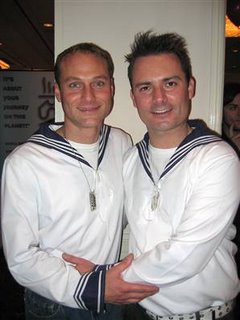
Congratulations! American Tony Mason and Brit Asa Cairns are in love and will soon marry in England. American Tony Mason, left, and Brit Asa Cairns now have the right to marry in a civil ceremony, but not in the United States. Mason has had to emigrate to England to have the right to marry his love.

The two lived together in Atlanta in the United States for two years, but even if Cairns had become a U.S. citizen, they still wouldn't legally have been a couple. That's why they're in England now, because under England's new Civil Partnership Act, they will be "spouses in the eyes of the U.K. government—and for the purposes of citizenship, hospital visitation rights, pensions, inheritance taxes and entitlement to most parental rights—the United States government will not recognize their union," says an MSNBC story.

England joins Canada, New Zealand, South Africa, and other nations in legalizing same-sex unions. The United States is backwards when it comes to human rights. We torture Iraqis and keep people in love from marrying, in obeisance to a twisted sense of right and wrong.

For shame, America ... for shame.


Thursday, December 08, 2005

Canadian-Style Health Care

I see, in looking at my blog stats, that quite a few Canadians are visiting EditorMom today. Welcome! Can you all get together and send someone down here to fix our health-care disaster? We could use a system like yours. Thank you. When you're done, I'll have tea waiting for you.


Wednesday, December 07, 2005

What Christmas Is Really About

Want to know the real meaning of Christmas? Forget shopping for presents. "Children Sleeping Under Bridges," a new hymn from Canadian composer Ronald Brown, tells the true story:


Children sleeping under bridges
MMdark December rain
Woman begging at the curbside
MMcoughing deep in pain.
Hopeless, fearing, desperate, daring
MMheadlights shining through the darkness:
They hear a baby cry.
Baby in the chafing straw
MMcrying just for them;
Wrapped in rags, he knows their pain
MMcrying just for them.


Young girl standing under streetlight
MMwaiting for a ride.
Suffocating in a fever,
MMnever had much pride.
Bruised, abandoned, no one caring;
MMshe cries her father's name:
And hears a baby cry.
Baby in the darkest night
MMcrying just for her;
Baby takes her pain and calls her
MMcalling only her.


Old man, cardboard house collapsing,
MMthis his only home;
Gasps and struggles, snow encrusted,
MMdying all alone.
Searching, needing, defeated, groping
MMcurses his life and all he's known:
He hears a baby cry.
Baby in a cold dark cave
MMcrying just for him;
Brought into this world to die
MMcrying just for him.


Rich man inside glass and steel,
MMsees the scene below.
There are barriers, layers, shadows
MMhe has never known.
Emptiness is his only guidance;
MMhe lives inside a void:
Yet hears a baby cry.
Baby calling out his name
MMthrough all time and space;
MMreaching for him, reaching for us,
MMcalling you and me.


_______________________
Words and music © 2005 by Ronald J. Brown. Reprinted here with permission of the composer.


Force-Feeding Hate Propaganda

Remember the New Mexico high school essay contest on why limiting marriage to heterosexuals is "vital"? My friend at Joyful Alternative has been at it again. She's written the New Mexico secretary of education (phone: 505-827-5800):


Dr. Veronica Garcia
Secretary of Education
Public Education Department
300 Don Gaspar
Santa Fe, NM 87501-2786

Dear Dr. Garcia:

On hearing that Piedra Vista [High School in Farmington, NM] held an essay contest on the topic “why limiting marriage to heterosexuals is vital,” I wrote the principal the
following letter. ...

Mr. Ortiz was kind enough to send me the following response:

I am sure you are somewhat misinformed regarding the essay issue. I only passed on what was sent to all administrators from the New Mexico Public Education Department. ...

I was surprised by his response because I had assumed that just one misguided or overwrought administrator had gone overboard. Instead, it’s an official directive to every school in the state.

Can you explain why all these children are being force-fed hate propaganda instead of taught what they’ll need to know to become upright citizens of our great country? Or why, if children must be propagandized, they can’t be required to write essays on what Jesus meant by “Love thy neighbor as thyself”? As a citizen, as a taxpayer, and as a Christian, I object.

I object as a human being, too. We had a child in a nearby school district who killed himself upon figuring out that he was gay; so imbued was he with the hate propaganda that he was therefore unacceptable to society and unworthy of life. Please don’t put your children at that risk.


Dr. Garcia, what do you have to say for yourself and your education department?


"Just Stop"

Stop the torture. Stop the killing. Stop the war in Iraq. Just stop. (Copyright © 2005 by Katharine O'Moore-Klopf.)

Fed up with the killing and the torture American soldiers are perpetrating in Iraq, I designed some artwork. You can buy it right now, from one of my CaféPress shops, on Postage Pals, stickers that go right next to the postage stamps on your snail mail. You can buy it on a T-shirt, on a sweatshirt, and on lots of other items. Please put the stickers on all of your mail and wear the shirts everywhere. Send a "Just Stop" T-shirt to your senators and representative. Give "Just Stop" sweatshirts as gifts to your peacemaker friends. Get the word out that we don't belong in Iraq.


Friday, December 02, 2005

Please Don't Spank or Slap Your Children, Take 2

Recently, I posted here about why hitting children is wrong. Jason wrote me privately with a different point of view. In the interests of getting the discussion of corporal punishment out in the open in the United States—not many Americans are willing to talk about it—I present the e-mail dialog between Jason and me, with his permission.

Jason:


I was wondering [what your post] was out to prove. I disagree ... [that] striking your child as a means of correction is wrong. You must be aware that a child learns a lot more from being punished in this fashon than you would like to think.

You [wrote:]

What are you teaching your children when you hit them?

  • That it's okay to hit someone smaller and weaker than they are
  • That their feelings don't matter
  • That their bodies are not their own
  • That adults can't control their own anger
  • That love equals hitting
  • That adults aren't to be trusted; one time they'll show affection, and the next time they'll hit
You should really add to this list that your child learns the following:

  • Don't do what it was that I am being punished for.
  • My parents deserve respect.
  • Dad has a good backhand (added for humor).
My opinion on this matter is that it is not the physical act of striking the child that will leave a mental reminder, but that the waiting for the punishment is truly the punishment in itself. For instance, little Jimmy takes a cookie before dinner after being told three times, "No cookies before dinner." The kid takes a cookie. Fine. Say, "Wait in your room until your father (or mother) gets home for a spanking. The child has to sit and wait for the spanking, thus thinking about what he or she has done. A lightbulb pops up in their head: "What could I have done to avoid this?" When the act of the spanking comes about, the child has already learned his or her lesson, so you don't have to wale on them. They might even walk away suprised that it didn't hurt as much as it was supposed to, but that is not the [point] here.

This is how I was raised, and I haven't yet been to prison (or in legal trouble). This idea of letting your children get away with anything is what is destroying this society and clogging our prison system (where again, no beating or physical abuse typically occurs). You do the crime, you do the time. I do, however agree, with you that outlandish phyiscal punishment [here, Jason is referring to my account of physical abuse by my parents] does not resolve as many issues as it is meant to.

Hopefully you can see that this topic truly has multiple angles. ... [It] is a worth [debating].


EditorMom:
Jason, thank you for writing. I agree that there are many points of view on the topic of physical punishment, and I think that this is a debate that should be out in the open in the United States. But you and I shall have to agree to disagree on whether spanking is a good thing.

Those of us who raise our children without spanking do not necessarily let them "get away" with anything. My sons—almost 11 and 4—are well behaved. (My daughter, now 22, was a well-behaved child too.) I have always set age-appropriate behavior expectations for them, [using] either natural consequences or removal of privileges [to help] them learn behavior boundaries. Here is an example of the first:

My 4-year-old demands something from me. He has been told on many other occasions that he is to speak politely and ask for what he wants. Because he has been rude, I refuse his demand, explaining why.

Here is an example of the second:

My almost-11-year-old has attention-deficit/hyperactivity disorder (AD/HD). One of the problems that people with AD/HD have is decreased self-control. I ask him to clean his room. He feels compelled to play yet another game on the computer before cleaning his room. I then inform him that he has lost computer privileges for the remainder of the day for not using self-control—for not cleaning his room first and then playing another game on the computer.

This works well for all of us. That's not to say that I don't occasionally lose control and yell when I'm frustrated by my children's misbehaviors. But when I do, I don't resort to spanking or slapping. Once I've cooled off, I apologize for my yelling (because it's a behavior I don't want them to emulate), and I explain which behaviors of theirs angered me so much. (The explanations are much shorter for the 4-year-old.) When my sons' misbehavior escalates, time-outs work well [as far as helping everyone to cool off]. After a time-out is over, I ask the child in question to explain why he got the time-out; this ensures that he is aware that the behavior in question is unacceptable.


Now that you've read Jason's take on this issue, I'd like to read yours. Have you spanked your children? Why or why not? Were you spanked as a child? How did it affect you? E-mail me and I may make your story into a blog entry.


Take 1

Presbyterians Speak Out Against Torture

At long last, my denomination, the Presbyterian Church USA (PCUSA), is speaking up about the torture of Iraqi prisoners of war by U.S. soldiers. I've been watching and waiting for my fellow Presbyterians to speak out against torture for some time now, and I'm so happy that they're doing so that it's worth reprinting here material from the PCUSA web site:
It's a sin to legalize torture [photo from the PCUSA Web site]Motivated by love of God and country, many Presbyterians are deeply saddened and morally outraged at the treatment of detainees by the United States and our allies. Out of this concern for our troops, our nation, and God's children, efforts at organizing and acting to stop torture have begun. Moderator Rick Ufford-Chase and the Rev. Ed Brogan, Director of the Presbyterian Council for Chaplains and Military Personnel, invite all who share this concern to gather in Miami, Florida, from 9:00 a.m. on Friday, January 6 through noon on Saturday, January 7, 2006. Participants will pray, study, worship, witness, strategize, and organize. Find more information and register online.

Advocate for Senator McCain's amendment providing that U.S. armed forces observe the humanitarian standards in international, national, and military law and our military's effective rules governing military interrogations.

Endorse the statement by the General Assembly of the National Council of Churches in Christ calling our government to denounce torture and affirm the moral principles that honor the dignity of all persons.

5 6 5 6 5 6


Harold Kurtz, Senior Associate of the Presbyterian Frontier Fellowship, writes, "Lately I feel like a stranger in the United States.

I am a remnant of what has been called "the greatest generation," but it's not the thinning ranks of my generation that has me feeling lost and confused. It's the debate about torture that has been swirling around me for months. I never imagined such a debate in my country."

A single statement from the executive branch that torture is forbidden everyplace, all the time, by every agency and under all circumstances, would stop all such talk immediately. There might be an element of danger in that stance, but virtue knows any sacrifice is worth a better future. We need to end the torture debate so the world will know that my country would never become as the enemy.

My father fought in World War I in Europe. He was a quiet man who never talked about his service in France, but my mother’s photo of him in his uniform is etched in the minds of his children.

When World War II broke out, we were five boys and a little sister. The three oldest enlisted within days of the declaration of war. As number four, I enlisted as soon as my 18th birthday rolled around. Three of us went into the Army Air Force for pilot training; one joined the 5th Armored Division.

My youngest brother, Dudley, graduated from high school a couple of years later. Dad and Mom did not stand in the way of his enlisting, although they could have gotten a deferment for him to help on the farm. Dud didn’t want cold, mud and tents, so he joined the Navy.

When his orders came to report for duty, what was left of the family climbed into the car and took him to the train station—his grandfather, a great aunt, his little sister and Mom and Dad. They all returned to our home to stay overnight.

Dad went immediately to the end of the backyard and dug up the basketball standard that had stood for many years over a dusty plot where running feet had trampled out every living thing. It was too painful to see it standing there, silent and unused.

After supper and evening visiting, Mom and Dad turned their bed over to company. They took the boys’ room; Mom crawled into Dud’s lower bunk, and Dad climbed into the top one. Finally, in the dark, alone, Mom was able to shed the tears that she had held back all day. Dad heard her crying and climbed down. They slept wrapped in each other’s arms in Dud’s empty, single bed. Mom wrote later, “When the morning came, our courage returned.”

It was common then for families to display in a window a small white flag with blue stars, one for each son serving in the war. Mom couldn’t find a flag with five stars on it to replace the previous one, so she took a blue crayon and colored on it a fifth star. Years later, when family memorabilia was divided up, the four older brothers awarded that flag to Dud as his keepsake. It was a silent reminder of our parents’ sacrifice.

Dud ended up on a minesweeper in Japanese waters. The brother in the ground forces landed with the 5th Armored Division, on D-Day plus four, and fought clear into Germany until VE day. Half of the soldiers in his unit were killed or wounded. The other three of us were Air Force pilots in Europe.

One day there was a knock at the door of our farmhouse. Mom looked out and saw the rural mail carrier’s car stopped at the mail box. She was afraid of its meaning. It was the custom of those carriers to hand-deliver registered letters from the government. My brother Merle had gone down in his P-51 and was missing in action. Good news came within the month: He was a prisoner of war, alive. He would be imprisoned for 11 months.

As we served and as my parents waited, we all felt strongly that we were fighting an evil an evil regime whose vicious tactics we would never employ. We acted on values that we could be proud of.

I flew with the Troop Carrier Command. On return flights after making deliveries to the front, we would stop at field hospitals and pick up the wounded. We arranged bunk-like stretchers on both sides of the plane to carry as many as possible, and delivered those critical wounded to the base hospital. Friend and foe alike. No one even asked.

I was also trained as a glider pilot. When the army needed to jump the Rhine River, I landed with a glider-load of airborne troops behind the German lines. We fought them for a strip of land needed for a pontoon bridge. We rounded up hundreds of POWs. When the area was secured, low-flying B-24s dropped “para packs” of ammunition and food from their bomb bays. As we fought the Germans outside our perimeter, we shared our K-rations with the POWs inside.

As the war in Europe ended, we flew out our prisoners. They were a skinny, battered and beaten lot. We also flew out forced laborers who were in worse shape. However, what seared my soul was the sight of survivors of the death camps walking skeletons, hollow-eyed, with barely enough strength to climb up the steps into our planes. I knew then that I could never be a pacifist, for such evil must never be given a free hand to rule the world.

What has happened to my country now? I am mystified by the continuing debate about torture. In the country I and my brothers fought for, torture wasn’t even mentioned as a possibility that was the enemy’s tactics. That’s part of the reason they were the enemy.

I am an evangelical Christian. Jesus tells us to eliminate our enemies by making friends of them.

Back on the farm, the harvest of 1944 was very difficult. Dad, Mom and little sister Joyce were alone. Meanwhile, the United States was finding it hard to keep and feed all the German POWs in camps in Europe. They started bringing prisoners to the States in returning troop ships.

A camp was established near our home in eastern Oregon. Word was sent out that farmers could hire willing prisoners as farm laborers. They would be brought to the farms by guards, and the farmers would pay a daily wage. Most prisoners were delighted to have something to do, and especially to be paid for their work. Dad decided to use their help with the harvest.

Three or four POWs would be brought to the farm each day. Dad and his prisoners worked well together even without a common language. The prisoners brought their lunch. But Dad and Mom were concerned about those young Germans; Mom worried about their diet. Every day at noon, she cooked up a big pot of stew or soup to add to their lunch. I am sure that as she stirred the soup, she prayed that someone would care for her POW son.

My dad must have had similar thoughts. One day when it was cold and windy and Mom was gone, Dad talked the guard into letting the prisoners into the house for lunch, although it was against regulations. Inside, one of the prisoners saw my dad’s guitar sitting in a corner and asked if he could play it. The prisoners sang a song they must have learned from their guards: “Don’t Fence Me In!”

In that same bitter winter in Germany, my prisoner brother was put in a railroad cattle car and shipped south. Half of his fellow POWs died on the way.

I am certain all of those German prisoners who worked on our farm went back to Germany not as enemies, but as friends.

What has happened to my country? How can my country be debating the merits of torture? Why has my country lost the will to make friends out of its enemies?


Just Following Orders

Remember the New Mexico high school essay contest on why limiting marriage to heterosexuals is "vital"?

My post on that subject got a few people mad enough to e-mail Donny Ortiz, principal of Piedra Vista High School in Farmington, in protest. One of them is my friend from Joyful Alternative, and this is what she wrote to Ortiz:


I expect you have by now received many comments on the inappropriateness of requiring your students to write essays on the topic of why heterosexual marriage must be preserved. You might instead have asked them more generally how families could be kept intact, and your students might have been challenged to think deeply and propose reverting divorce laws back to the standards of the 1960s, raising the minimum wage to $10 per hour, or any number of other solutions.

But I see you are following the directives of some outfit called United Families International, whose Web site features stirring (although written as if by the average inth-grader) polemics against women earning pay equal to men's, because, after all, women naturally benefit from their husbands' higher pay, so they're not really losing anything. Therefore, your (and their) objective is not developing your students' thinking and writing skills; the objective is propagandizing students against nonheterosexuals and their rights to life. Frankly, I've been wanting to know exactly how my lesbian neighbors' existence can ruin my relationship with my husband and my marriage, because this whole line of attack makes no sense to me; from the objective evidence, they're better parents than I am, for one point. If any of your students' essays cast light on this question, please forward it to me.

Since you've apparently abandoned No Child Left Behind in favor of the directives of this dubiously credentialed private organization, I'm wondering instead about next semester's essay question. Is it "Why should illegal immigrants be summarily executed?" Maybe "Why is torture effective in learning which pupil hid the classroom wastebasket?" or "Why should your parents vote for school board candidates who are members of United Families International?"


Ortiz sent my friend an I-was-just-following-orders response:

I am sure you are somewhat misinformed regarding the essay issue. I only passed on what was sent to all administrators from the New Mexico Public Education Department. I cannot take credit from those who praise the essay, nor from those who are offended by it.

You raise some very interesting points in your message to me. I appreciate your willingness to let me know how you feel, and I respect that. I will continue to work hard on behalf of all students to improve our lives and our future, regardless of their religion, ethnicity, etc.


But notice that Ortiz didn't include sexual orientation or gender identity in his list of "regardlesses," still managing to avoid any responsibility for fostering discriminatory attitudes in his students.

You can e-mail the school district here.


Thursday, December 01, 2005

What Drug Is Bush Taking?

I'd like to know what drug the evil chimp in chief is taking that makes him think that the American people will believe him when he keeps saying the same thing over and over about Iraq:

Iraqi forces have made real progress. . . . We will stay as long as necessary to complete the mission. If our military leaders there tell us we need more troops, I will send them.

That's what he said yesterday, and it's what he's said since the war began. This man has no imagination, and he cannot think for himself. If he could, he'd see the Iraq war for the fiasco that it is and come up with a plan for extricating American soldiers. He has no grasp of reality; at least with this latest round of presidential bull hockey, analysts such as those at the Associated Press, the New York Times [free registration required] and UPI have no qualms about saying so.

We have no business being in Iraq. And Bush has no business being president.


Tuesday, November 29, 2005

The Gray Lady Weighs in on White Phosporus

Finally, the New York Times editorial page [free registration required] has addressed the use of white phosphorus by U.S. troops against Iraqis. It's about time, and it's right on target—except that we shouldn't be in Iraq in the first place:

Shake and Bake
Let us pause and count the ways the conduct of the war in Iraq has damaged America's image and needlessly endangered the lives of those in the military. First, multilateralism was tossed aside. Then the post-invasion fiasco muddied the reputation of military planners and caused unnecessary casualties. The W.M.D. myth undermined the credibility of United States intelligence and President Bush himself, and the abuse of prisoners stole America's moral high ground.

Now the use of a ghastly weapon called white phosphorus has raised questions about how careful the military has been in avoiding civilian casualties. It has also further tarnished America's credibility on international treaties and the rules of warfare.

White phosphorus, which dates to World War II, should have been banned generations ago. Packed into an artillery shell, it explodes over a battlefield in a white glare that can illuminate an enemy's positions. It also rains balls of flaming chemicals, which cling to anything they touch and burn until their oxygen supply is cut off. They can burn for hours inside a human body.

The United States restricted the use of incendiaries like white phosphorus after Vietnam, and in 1983, an international convention banned its use against civilians. In fact, one of the many crimes ascribed to Saddam Hussein was dropping white phosphorus on Kurdish rebels and civilians in 1991.

But white phosphorus has made an ugly comeback. Italian television reported that American forces used it in Falluja last year against insurgents. At first, the Pentagon said the chemical had been used only to illuminate the battlefield, but had to backpedal when it turned out that one of the Army's own publications talked about using white phosphorus against insurgent positions, a practice well known enough to have one of those unsettling military nicknames: "shake and bake."

The Pentagon says white phosphorus was never aimed at civilians, but there are lingering reports of civilian victims. The military can't say whether the reports are true and does not intend to investigate them, a decision we find difficult to comprehend. Pentagon spokesmen say the Army took "extraordinary measures" to reduce civilian casualties, but they cannot say what those measures were.

They also say that using white phosphorus against military targets is legal. That's true, but the 1983 convention bans its use against "civilians or civilian objects," which would make white phosphorus attacks in urban settings like Falluja highly inappropriate at best. The United States signed that convention, but the portion dealing with incendiary weapons has been awaiting ratification in the Senate.

These are technicalities, in any case. Iraq, where winning over wary civilians is as critical as defeating armed insurgents, is no place to be using a weapon like this. More broadly, American demands for counterproliferation efforts and international arms control ring a bit hollow when the United States refuses to give up white phosphorus, not to mention cluster bombs and land mines.

The United States should be leading the world, not dragging its feet, when it comes to this sort of issue—because it's right and because all of us, including Americans, are safer in a world in which certain forms of conduct are regarded as too inhumane even for war. That is why torture should be banned in American prisons. And it is why the United States should stop using white phosphorus.


Saturday, November 26, 2005

Teaching Prejudice in School

Apparently discrimination is part of the curriculum at Piedra Vista High School in Farmington, New Mexico. Parents there must be proud that their children will grow up to be bigots.

One of the topics in an essay contest there is why limiting marriage to heterosexuals is "vital." The contest isn't set up the way many are—here's the topic, pick your stance, and support it. No, everyone participating in it is supposed to either defend the denial of full human rights to gay and lesbian people or explain why abortion is detrimental to society. The essay contest is being held in conjuntion with one by United Families International, an organization whose primary mission is "to strengthen the family by promoting marriage between one man and woman and the protection of human life, including unborn children."

School's purpose is to teach children to think, not to teach them prejudice. E-mail Principal Donny Ortiz or write him at Piedra Vista High School, P.O. Box 5850, Farmington, NM 87402, to say so.


See update.


Friday, November 25, 2005

Getting Started as a Freelance Editor

Are you thinking about becoming a freelance copyeditor or editor? Perhaps you're ready to leave the corporate world, or you've been laid off, or you'd prefer the flexibility that working for yourself can offer. How do you market yourself to establish and build your business? Do you know what skills you need, and what resources are available for you to develop those skills? What computer resources will be necessary? And what about money—how do you charge for your work, budget for the slow periods, deal with invoicing and contracts?

"Getting Started as a Freelance Editor," a 90-minute interactive audio conference from Copy Editor newsletter, will tell you what you need to know. This first-ever event will bring you together with two seasoned editors with 21 years of freelancing experience between them. Your presenters will be Wendalyn Nichols, editor of Copy Editor, and yours truly.

When:
Tuesday, January 10, 2006
11:30 am–1:00 pm Eastern
10:30 am–12:00 pm Central
9:30 am–11:00 am Mountain
8:30 am–10:00 am Pacific


Pricing (in U.S. dollars):
Audio conference (per dial-in site):
$169 (Copy Editor subscribers)
$189 (nonsubscribers)

CD:
$169 (Copy Editor subscribers)
$189 (nonsubscribers)

Audio conference and CD:
$229 (Copy Editor subscribers)
$259 (nonsubscribers)


Here's what you'll learn:

  • First Steps: The freelancer personality * The basic skills you need * Points of entry * The resources that can provide advice and support * The different types of work available * What kinds of software you need * What equipment and reference works you need

  • Building Your Business: Getting the word out * Getting first clients * Ongoing marketing * Determining whether you need a Web site * How to get more skills

  • Managing Time and Money: What to charge for what kinds of work * Whether to charge by the hour, the page, or the job * What work pace is considered usual * How to plan your time * Putting aside money for vacations, sick days, and taxes * Budgeting for an unpredictable income

  • Communicating as a Professional: Dealing with contracts * Invoicing * Dealing with clients who haven't paid on time * Communicating with clients and authors


For more details and to register, go here.

Updated 5/24/06: Now that the audio conference has passed, you can purchase an onscreen booklet on getting started as a freelancer directly from me.


Wednesday, November 23, 2005

What I Give Thanks For

Kathy and Ed: two old hippies in loveKathy and Ed: two old hippies in love

This Thanksgiving, I'm thankful for many people and things, described here in stream-of-consciousness order:


  • My husband, Ed, who is my best friend, an excellent father to our three children, a talented cabinetmaker, and owner of the world's kindest heart

  • My daughter, Rebecca, who at 22 is intelligent, level-headed, people-smart, and fun to be with

  • My son Neil, who at almost 11 is intelligent, very detail oriented (couldn't have inherited that trait from his copyeditor mom, could he?), serious, big-hearted, and introverted

  • My son Jared, who at 4 is cheerful, boisterous, musically inclined (can't help dancing anytime he hears music), extroverted, and huggy

  • My cats Snuggles and Emily, whose purrs and nuzzling have cheered me up on many a gloomy day

  • My in-laws, D. and A., who though they used to drive me batty, have become my good friends and close family members—and child-care providers and errand-runners so that Ed and I can work full time

  • Being self-employed, which keeps me out of stupid office politics and stuffy business suits and lets me be at home exactly when my children need me to be (which is all the time) and allows me to earn money by doing what I love—reading all day long!

  • The ubiquity of e-mail lists (my favorite is Copyediting-L), which has decreased the isolation of those in my profession exponentially

  • My real-life friends Martha S., Lisa G., Marie S., Karen S., Glenn C., and Barbara M.

  • My numerous cyberspace friends

  • My brother Wally and my sister Becky, whom I wish didn't live in Texas, so far away from my New York State home

  • The Rev. Molly Blythe Teichert, who was the pastor of my Presbyterian church for nearly 11 years and is now moving on to another church, and who taught me that Christianity isn't the right-wing zealots who grab the news headlines (and among whom I grew up) but is instead people who actively love others and work to make the world a better, more loving place

  • The availability of good medications and therapy for treating Ed's, Neil's, and A's attention-deficit/hyperactivity disorder (AD/HD)

  • The advances in education that have made individualized education plans (IEPs) possible, so that children in public schools get the educational situations they need to let their intelligence shine; without this, Neil's AD/HD would get in the way of his blossoming genius—and what a great loss to the world that would be

  • The teachers, teaching paraprofessionals, and counselors of Eastern Suffolk Board of Cooperative Educational Services, including Sayville Learning Center and Jefferson Academic Center, who have helped Neil's intellect and social skills unfold beautifully

  • A warm house

  • Plenty of food

  • Fellow bloggers, such as Peter Fallon at In the Dark, Erinberry at Jesus Was Not a Republican, KZ at (Not So) Little Feat, Kathy at Liberty Street, and Bill Blinn at Bush Bytes, who have the courage to always tell it like it is

  • My clients, who constantly come up with fascinating and challenging projects for me to work on

  • My church choirmates Donna and Gale, whose wonderful alto voices keep me singing the part I'm supposed to be singing

  • Blogger, which hosts this blog

  • Edward Wang, MD, who repaired my arm after I broke it almost three months ago

  • Roger Ewonkem, MD, who recently prescribed a medication that relieves the restless leg syndrome that had stolen my sleep for 11 years

  • Avocados, shrimp, olives, Southern fried chicken, chicken cooked in my slow cooker, white wine, retsina, whole-leaf green tea and white tea

  • Candles, potpourri, scented oils

  • Purple

  • People with the courage to be open and kind

  • Hugs

  • Political gear: coffee mugs and T-shirts and bumper stickers and tote bags

  • My adopted moms, Winnie and Estelle

  • My in-laws' dog, Sandy, who's addicted to affection and whose fur is as soft as velvet


Tuesday, November 22, 2005

Sounds Like Grounds for Impeachment

Just 10 days after September 11, 2001, MSNBC reports, Bush was advised that "U.S. intelligence found no credible connection linking the attacks to the regime of Saddam Hussein, or evidence suggesting linkage between Saddam and the al-Qaida terrorist network, according to a report published today in the National Journal." He kept this information from the Senate committee charged with investigating the matter.

The report ... cites government records, as well as present and former officials with knowledge of the issue. The information in the story, written by National Journal contributor Murray Waas, points to an abiding administration concern for secrecy that extended to keeping information from the Senate committee charged with investigating the matter.

In one of the Journal report's more compelling disclosures, Saddam is said to have viewed al-Qaida as a threat, rather than a potential ally.


Presidential brief
The president's daily brief, or PDB, for Sept. 21, 2001, was prepared at the request of President Bush, the Journal reported, who was said to be eager to determine whether any linkage between the Sept. 11 attacks and the Iraqi regime existed.


And a considerable amount of the Sept. 21 PDB found its way into a longer, more detailed Central Intelligence Agency assessment of the likelihood of an al-Qaida–Iraq connection.


The Journal story reports that that assessment was released to Bush, Vice President Cheney, then–national security adviser Condoleezza Rice, then–Secretary of State Colin Powell, and other senior policy-makers in the Bush administration.

The Senate Intelligence Committee has requested from the White House the detailed CIA assessment, as well as the Sept. 21 PDB and several other PDBs, as part of the committee's continuing inquiry into whether the Bush administration misrepresented intelligence information in the months before the start of the war with Iraq in March 2003.

The Bush administration has refused to surrender these documents.

“Indeed,” the Journal story reported, citing congressional sources, “the existence of the September 21 PDB was not disclosed to the Intelligence Committee until the summer of 2004.”


Long-alleged connection
After Sept. 11, the administration insisted that a connection existed between Iraq and al-Qaida. President Bush, in an October 2002 speech in Cincinnati, said the United States had “learned that Iraq has trained al-Qaida members in bomb-making and poisons and gas.”

And Vice President Cheney, in a September 2003 appearance on NBC's Meet the Press, alleged there was “a relationship between Iraq and al-Qaida that stretched back through most of the decade of the ’90s.”

But the National Journal report said that the few believable reports of contact between Iraq and al-Qaida “involved attempts by Saddam Hussein to monitor the terrorist group.”

Saddam considered al-Qaida “as well as other theocratic radical Islamist organizations as a potential threat to his secular regime,” the Journal reported. “At one point, analysts believed, Saddam considered infiltrating the ranks” of al-Qaida with Iraqi intelligence operatives as a way to get more information about how the organization worked, the Journal said.


Journal: Little has changed
The Journal story asserts that little has changed to refute the initial absence of information linking Saddam and the al-Qaida network.

“In the four years since Bush received the briefing, according to highly placed government officials, little evidence has come to light to contradict the CIA's original conclusion that no collaborative relationship existed” between Iraq and al-Qaida, the Journal reported.

Reporter Waas quotes one former administration official, whose assessment is a problematic contradiction of the administration’s longstanding assertions:

“What the President was told on September 21 was consistent with everything he has been told since—that the evidence was just not there.”

If that's not grounds for impeaching the evil chimp, I don't know what is. The only trouble with impeaching him is that Cheney would then be president. Can we impeach both monsters at the same time?

Template created by Makeworthy Media