KOK Edit: Your favorite copyeditor since 1984(SM)
KOK Edit: your favorite copyeditor since 1984(SM) KOK Edit: your favorite copyeditor since 1984(SM) Katharine O'Moore Klopf
Blog

Thursday, June 28, 2012

Why I Love Twitter

I'm reposting this, with a wide grin, from the e-mail list of the Editorial Freelancers Association, with permission of the original poster:

Hi, Katharine,

I took your [April 3 EFA] teleconference on "Using Twitter to Build Your Freelancing Business." I've put about 20 tweets on my Twitter account. Must try to do it three times a day as you suggested.

I was so happily surprised today to get a job editing a doctoral dissertation for a computer science student at USC. I asked him where he got my name, and he said he found it on Google, and then read my tweets! So I typed "Editing USC doctoral dissertations" in Google, and lo and behold my name appeared at the bottom of the first page, with a link to my Twitter account! I am definitely going to keep posting to Twitter.

Thank you for the course, Katharine. Do I owe you a finder's fee?

Mary-Anne Pops
@PopsEdit
http://www.drpopsedits.com


Wednesday, June 27, 2012

Gratitude from and for Authors

I just got promoted again.

One of the newest of my authors who are non-native English speakers, this one from China, wrote me to thank me for my editing. He addressed me as "Professor Katharine." :-) His thank-you is wonderful:

I am very impressed by your work and your precious effort and efficiency in editing this article. I have reviewed it and made revisions and answered the questions. Hopefully you can afford us further precious refinement of this paper.


Dear author, you have made my day.


Monday, June 25, 2012

Communicating in Images

Explaining imaging in spine surgeryA picture is indeed worth a thousand words.

While I was editing a journal manuscript for one of my authors from Japan who is a non-native English speaker, I was having trouble understanding what he meant to say in one particular sentence. The topic was imaging in spine surgery. He had written:

In spinal deformities, image quality is inferior because radiation does not incident parallel to the vertebrae endplates.

I e-mailed him and asked him to explain it to me, so he drew and then e-mailed a helpful diagram to me (shown here at left). I immediately understood that this was what he wanted to say:

In spinal deformities, the image quality is inferior because some of the vertebral endplates are oriented obliquely to the radiation source rather than parallel to it.

I wrote back right away to thank him and tell him that he is an excellent teacher. I was delighted that he had realized that the best way around the language barrier between us was visual. Close collaboration like that is one of the many reasons I find it so satisfying to work with researchers who are non-native English speakers.

publishing

Friday, June 22, 2012

"And Thus the Voyage Ended"

This makes me so sad. TSTC Publishing is closing down because of budget cuts.

TSTC PublishingTSTC Publishing was both an editing client of mine and the publisher of the first textbook I ever coauthored. Everyone who worked there is talented, and I loved working with them. Mark Long has been a visionary publisher, leading this nimble little publishing house through lots of innovations that the behemoths are only thinking about doing. Any publisher who snaps him up will benefit hugely. And Ana Wraight, you know I'll be here to mentor you as you decide whether to work for another publisher in-house or go freelance.


Monday, June 18, 2012

Is Editing Just Checking Spelling and Grammar?

Sometimes authors who are non-native English speakers come to me after reviewers for a biomedical journal have told them that their manuscript needs attention by an editor who is a native English speaker—even though the manuscript has been already "edited" by an English-language editing service. When I see that issues such as the following have slipped by supposedly professional editing services, I'm dumbfounded.

An article I recently edited concerns hip arthroplasty. Before I edited it, one particular sentence read like this:

Skin retraction was performed for 3 weeks, and there was no recurrence of dislocation.

This was my reaction, which of course I did not record in the manuscript: The incision was left open, with the skin retracted, for 3 weeks?! Or did surgery happen in extremely slow motion, with it taking the surgeon 3 weeks to retract the skin?!

This is how that sentence should have read:

The patient was placed in skin traction for 3 weeks, and dislocation did not recur.

Here is an explanation of skin traction, which is definitely not the same thing as skin retraction.

Spelling checkers and editing macros can help catch spelling errors and decrease time spent on rote editorial tasks, respectively, but they can't replace human editors. Good editing requires the use of a brain.

publishing

Wednesday, June 13, 2012

Copyediting Drug Names

Medical editors aren't the only ones who have to deal with drug names in the manuscripts they edit. In this guest post, my colleague Laura Poole, who is such a talented editor that she teaches newcomers to the trade, shares her strategies for handling drug names in nonmedical manuscripts.


My first job after college was with a company that developed training for pharmaceutical sales reps, and it taught me a lot about trademarked drug names. In the materials we created, we had to make sure the drug name was handled correctly every time it appeared—that is, with any unique registered marks and trademarks, capitalization, hyphenation, or other symbols. I remember my boss specifically saying, "Make sure the drug name isn't hyphenated at the end of a line, because that constitutes trademark violation, and they could sue us!"

Thankfully, I no longer have to worry so much about that kind of accuracy. However, that knowledge of and sensitivity to these terms has come in handy over the years as I branched out to work in scholarly nonfiction. I come across materials that are nonscientific or nonmedical in nature that reference particular drugs. Major style guides have some rules for how to handle trademarked terms, but I feel that drug names are a bit of a special case. (Maybe I'm still paranoid from that first job.) So I've developed a variety of alternatives when I encounter brand-name drugs in materials I edit.

My two preferred style guides, Chicago Manual of Style (16th edition [CMS]) and the Publication Manual of the American Psychological Association (6th edition [APA]), have the following to say.

CMS 8.145: Generic names of drugs, which should be used wherever possible in preference to brand names, are lowercased. Brand names must be capitalized; they are often enclosed in parentheses after the first use of the generic name.

The patient takes weekly injections of interferon beta-1a (Avonex) to control his multiple sclerosis.

CMS 8.152: Although the symbols ® and ™ . . . often accompany trademark names on product packaging and in promotional material, there is no legal requirement to use these symbols, and they should be omitted wherever possible.

APA 4.16, similar to CMS, states that trade and brand names of drugs should be capitalized (generics should be lowercase).

An issue is that many brand names have become common language. Just as Kleenex and Xerox have entered our lexicon and are used in a loose way these days, we throw around common or well-known drug names such as Viagra, Prozac, and Claritin. Sometimes it serves the text to be able to further identify these substances; alternatively, it might improve the text to do away with the trade names where possible. So beyond the CMS and APA guidelines, I find a few other options to be useful choices, and I outline them here.

First, when encountering a drug name in text, look it up online to confirm correct spelling, any hyphenation that needs to be retained, and the generic name of the drug. You can almost always find more information by typing www.[drugname].com into your browser.

If the drug is mentioned in passing only once or twice, you might be able to substitute the broad type or class of drug for a brand name or a generic name. For instance, if the brand name or generic name isn't key to the narrative, "John takes Prozac" might easily be changed to "John takes an antidepressant" or "John takes a selective serotonin reuptake inhibitor" (a bit of a mouthful!). Other examples:

  • Sally takes ACE inhibitors to treat her high blood pressure.
  • The pharmacist filled a prescription for a calcium channel blocker.
  • The doctor prescribed antipsychotics to decrease hallucinations.
  • Antibiotics are used to treat most ear infections.
  • Antiretrovirals are effective at treating HIV.
If you can use the generic to identify the drug (i.e., the brand name isn't key to the discussion) in almost all cases, then do so, and follow the CMS and APA guidelines. Thus, "John takes Prozac" might be changed, in this case, to "John takes fluoxetine," and you would continue to use fluoxetine every time it appears. If you're following CMS, you would say, "John takes fluoxetine (Prozac)." This gives a bit of a hat tip to the brand name, and you only need to identify it at first use. Examples:

  • Anne takes propranolol (Inderal) to treat her panic disorder.
  • Joe took methadone (Dolophine) as part of his rehab program.
  • The doctor prescribed a maintenance dose of levothyroxine (Synthroid).
You can also reverse this and primarily use the brand name, identifying the generic at first mention in parentheses. Save this for when the brand name itself might be more important to the text, or for those times when the generic name might be very long and it is shorter to use the brand name. Examples:

  • The doctor usually prescribed Haldol (haloperidol) for her patients with schizophrenia.
  • The gold standard of treatment for edema is Lasix (furosemide). [Note: These first two are examples are cases in which the brand name has entered the lexicon and is very well known.]
  • Viagra (sildenafil) is the most well-known of the so-called lifestyle drugs. [Note: In this case you definitely need the brand name because the text discusses a specific product.]
  • Phil Mickelson endorses Enbrel (etanercept). [Note: This one must retain the trade name because Mickelson is endorsing a specific brand-name product.]
  • Cialis is a competitor drug to Viagra.
  • BiDil (isosorbide dinitrate and hydralazine) is considered a commercial failure. [Note: The brand name is under discussion; also, the generic name is very long, so the trade name would be shorter and handier to use.]
Sometimes I hedge my bets with a parenthetical statement or addition to a footnote that indicates manufacturer information. This would be appropriate for certain materials—for instance, a text that compares various drugs that treat a particular condition, or material that discusses the pharmaceutical industry at large. Here are some examples:

  • Sildenafil (sold by Pfizer under the trade name Viagra) is a blockbuster drug.
  • Viagra (sildenafil; Pfizer) is a lifestyle drug.
  • When its patent protection ran out, zidovudine (originally marketed as Retrovir by Burroughs-Wellcome) was soon available in a generic version.

______________
Laura Poole is the owner of Archer Editorial Services, providing professional copyediting to scholarly publishers. She is also the cofounder of Editorial Bootcamp, which provides online and in-person training for copyeditors and publishers.

Where to find Laura: editorial trainingeditorial servicesbusiness coaching


Friday, June 08, 2012

How an Editor's Style Sheet Can Help the Author

There's more to editing a manuscript than just fixing spelling, punctuation, and grammar. We copyeditors must keep track of a good many things in a manuscript to ensure that the finished book or article is consistent throughout and doesn't jar the reader by odd deviations from its intended structure, message, or voice. What are some of these? Proper spelling and capitalization of jargon, for a start. There's much more, such as chronological numbering of chapters and references, physical and personality traits of fictional characters, and how ranges of numbers are handled.

To do all of that, we create a document called a style sheet as part of the editing process. (Here are examples to download as PDFs: for a novel, for a book of literary criticism, for a medical textbook.) The style sheet then serves as a reference for anyone who deals with the manuscript later in the publishing process, including the author, the proofreader, the production editor, and the indexer.

Recently, several colleagues and I had a discussion on Facebook about an author's gratitude for my creation of a style sheet for her book. Editor and writer Patrick Inman offered an excellent explanation of the value of editors' style sheets for authors, and he has allowed me to share it here:

Authors are often too close to their material to consciously organize it. Also, for some writers at some points in the process, explicit sorting and categorizing may interfere with necessary ambiguity in thinking—ambiguity that has to be clarified in the writing but shouldn't be clarified too early in the development of a piece. When someone else provides that explicit organization in a style sheet, the suggestions it contains can be both supportive and freeing. The author can take the advice, or leave it, or, most likely, use what works and reject what doesn't.

Style sheets promote and enforce consistency. Just as important, they identify and catalog inconsistencies, and in so doing may point out where and how the editor has misunderstood the writer's intent. Clear points of misunderstanding are great signposts for authors. The editor's misapprehension shows the writer where readers may get lost. If the author believes the editor has managed to approach, read, and react to the text approximately as intended readers will, any text passages or patterns that the editor misidentifies or miscategorizes deserve close attention. The writer can figure out what he or she wants to happen at those junctures, and revise the text to make the trail clearer, or to make the puzzle more prominent, but in any case to create a more deliberate pattern that either gets to the point or creates purposeful confusion or questions in the reader's mind.

The most enjoyable and possibly headache-provoking editing gigs in the world must include continuity editing for the best mystery writers. I imagine those style sheets track what the reader knows when as part of their structure, including the misleading clues.

See the "Circuitry" section on pages 30–52 in Thomas McCormack, The Fiction Editor, the Novel, and the Novelist (Paul Dry Books, 2006) for more on this. McCormack describes, with intricate examples, what he judges to be two of three essential tasks of novel editing: the acts of discovering or inferring and then communicating to the writer, first, how the text overall and at each point affects its ideal appropriate audience (the editor must have the sensibility to experience the text as those readers would), and second, how the narrative causes those effects (the editor must have developed the craft to make informed guesses as to what may be causing undesired effects).

McCormack wants us to always be aware that the point of editing is to offer clues and tools to the writer that may guide the writer in generating, revising, cutting, and structuring the work to achieve the writer's purposes. We can also help the writer decide what those purposes are by demonstrating what the current draft accomplishes or seems close to accomplishing. That may or may not be what the writer wants.


Friday, June 01, 2012

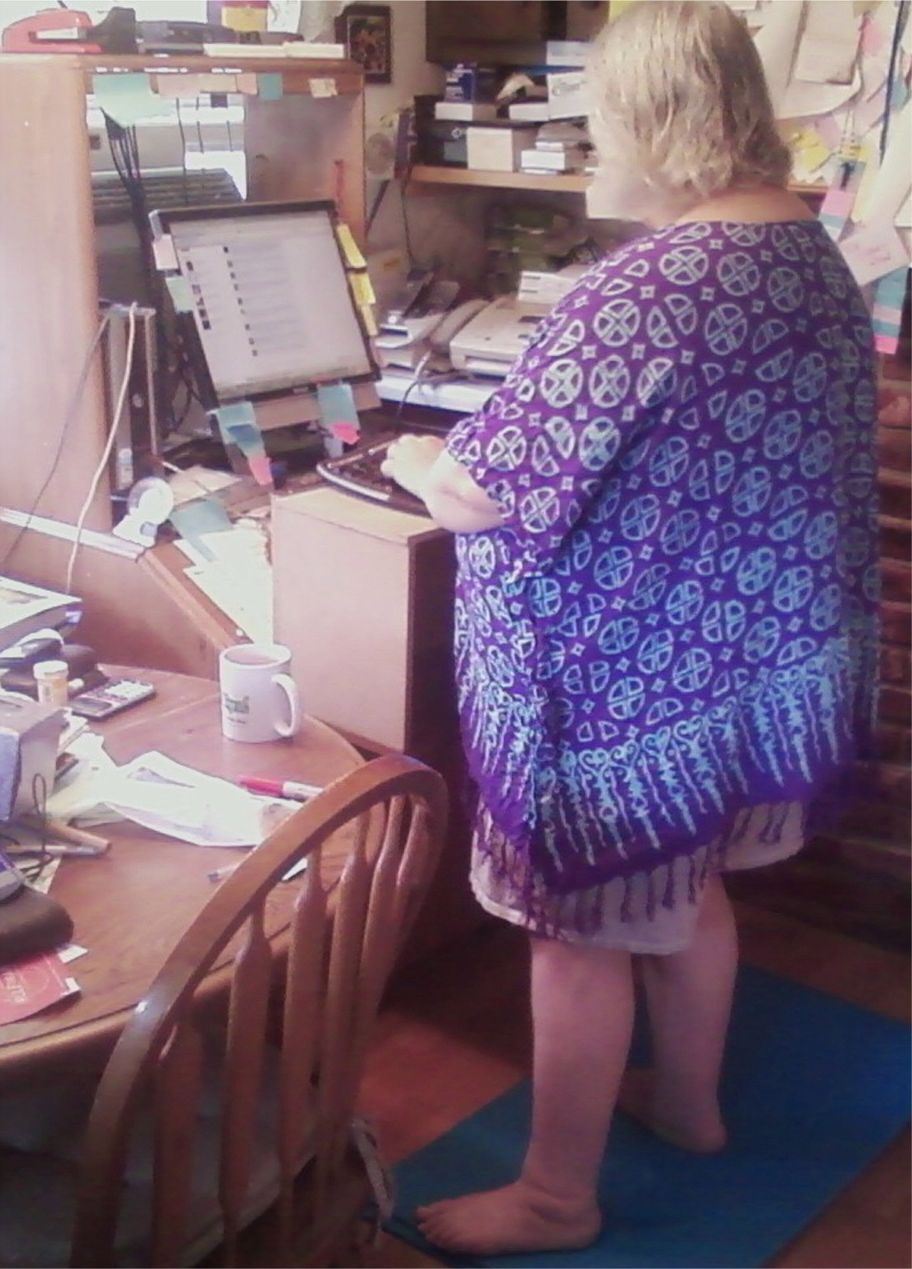
Why I'm a Convert to Standing at Work

Standing while I edit at my new sit–stand desk
I love my new sit–stand desk. When I stand while I work, I feel more alert, more in charge, physically lighter, unchained from my desk, and more cheerful. Using standing desks or sit–stand desks is becoming popular, in part because other people have experienced those same feelings when they stand on the job rather than sit. Gut-level enjoyment is what will get more people to stick with standing at work after they try it. But there are other reasons to avoid sitting all day long, ones that I find compelling.


The Backstory
I've been self-employed full time since January 1995. I edit all day long, and for most of those 17 years, I sat all day long too. I sat in front of my computer, which itself sat in a roll-around computer cart in a corner of my kitchen, because my home is small and has no spare room eligible for conversion to an office. Hardcover and paperback reference works, copies of journals I had edited, and paperwork sat stacked wherever I could find a bare countertop, because I had no office shelves. I had no real desk, so I glommed the kitchen breakfast table.

My sit–stand desk lowered for seated editing
I gave birth to two boys, one in December 1994 (a mere 2 weeks before I began freelancing full time) and one in 2001. When they were very young, I would do things to squeeze in more work to compensate for the time it took to care for them. For example, when they were babies, I often wore them in a sling-style cloth carrier, and they would fall asleep in the sling as they were breastfeeding. A happy baby meant I could work without interruption for a while. Later when they were mobile, I would close all the baby gates so that they were closed into my workspace with me, as if we were toddlers together inside a giant playpen. As they played with toys and crawled and then toddled nearby, I worked at my computer, seated. I often took time out to play with them or read to them, but I was sitting as I did so.


The Equation of Consequences
It didn't occur to me back then that I could edit while standing. I thought that standing at work was for people with very physical jobs, like my husband, who is a cabinetmaker. There aren't many work-related tasks that he can do while seated. If he's not on his feet moving around, he's not making money. But editing doesn't require walking back and forth from one piece of equipment to another, so because I was hyperfocused on building my editing business, my personal motto became "If I'm not sitting, I'm not earning." Eventually I encountered this equation:

constant sitting + a disinclination to exercise (a family tradition!) + three cesarean sections (my daughter was born in 1983, well before I began freelancing) + a carbohydrate-heavy diet (another Southern family tradition!) + a family history of diabetes (type 1 in my father and type 2 in my mother) = a gradual weight gain of 139 pounds, high blood pressure, high cholesterol levels, and type 2 diabetes

By 2010, I was taking several medications for diabetes, plus medications for hypertension (high blood pressure), hypercholesterolemia (high cholesterol levels), and hypothyroidism (underfunctioning thyroid). That's expensive. And it's emotionally distressing, especially because I am a medical editor: I know all about healthy behaviors, including getting exercise and eating a low-carb diet rich in fruits and veggies. But I hadn't been engaging in those healthy behaviors. So I changed the way I eat. I didn't "go on a diet." I changed the types of foods I eat and the quantities of food that I eat. The glycemic index is my friend. I'd stopped drinking soda years ago because I know what all that sugar can do to the body on so many levels. I began losing weight. But it didn't go very quickly, and every afternoon after lunch, I still felt sluggish and mentally dull. What was I doing wrong?

I wasn't moving. It was that simple. Sit all day long, and you'll lose muscle tone. Sit all day long, and you don't use much energy, so your body ends up with too much fuel hanging around that it doesn't burn off. Sit all day long, and your blood doesn't circulate as well as it should. That leaves you at risk for deep vein thrombosis (blood clots in the major veins), pulmonary embolism (blockage of blood vessels in the lungs by blood clots), and all sorts of other nasty physical consequences. I began reading more and more articles about the effects of too much sitting, and I became determined to find a way to stand while I work.


The Dream
I prefer working on desktop computers to working on laptops, so I wasn't going to get a laptop and just move from room to room in my house, standing sometimes and sitting other times. I came across a blog post by freelance translator Corinne McKay about her "treadmill desk." (Be sure to read her follow-up post.) This part of her post excited me:

Exercising while you work has been in the news of late, ever since Dr. James Levine, an obesity researcher at the Mayo Clinic, posited the idea that most desk-based workers would lose about 50 pounds a year if they walked at a very slow (1 mile per hour or less) speed while working, rather than sitting in a chair.

I tracked down an article about Levine in USA Today. But though I dreamed about getting his Walkstation, I knew that I couldn't afford $4,000-plus for a desk. And I read this article, which led me to the GeekDesk. That was much more affordable but still a large chunk of money. So I gave up on the idea for a while.

At my old improvised standing desk
But Cabinetmaker Husband had a temporary solution. He built a foldable box that I could set atop my computer cart's rollout so that I could place my keyboard and mouse on it to raise them to a level that I found comfortable for working while standing. It worked great and was very cheap. But it was heavy. And I found it a pain to set up and take down repeatedly during a workday.


The Sit–Stand Desk
Finally, in April of this year, Cabinetmaker Husband felt bad enough for me, hearing me talk about my dreams of an easier way to stand at work, that he sat down with me and drew up plans for a custom sit–stand desk, one that would allow me to alternate between sitting and standing. I knew, from all the reading of medical journals that I do, that this standing thing shouldn't be all or nothing. Yes, it's bad for your body if you sit all day, but it can be hard on your joints when you stand without reprieve or without moving around. So the plans that he created for my desk showed a stationary left side, with a pullout where I could do paperwork while seated, and a right side that I could raise and lower at the touch of a button. Here's a slide show (7.3 MB) about my desk's creation.


Money-Saving Alternatives
Before you ask whether my husband can make a custom sit–stand desk for you, you'll need to know that custom desks aren't at all cheap. All of the materials—lumber, hardware, and desk lift together—cost about $400. But that $400 is much less than what I could have paid. My husband saved us a lot of money by purchasing an electric scissor car jack to lift the standing portion of my desk; it's hidden under the desktop. The pneumatic lifts used in many commercially available desks cost between $800 and $2,000. Also, if I had had to pay my husband for his labor, just as his clients have to pay him, that would have been an additional $4,100 or so. And if I were a client of his who didn't live in the area, I also would have had to pay huge shipping costs, because this desk is heavy. Finally, once the desk was delivered, I'd have had to assemble it.

But don't despair if your budget is small or if you don't have a life partner who is a cabinetmaker. Lots of people improvise ingenious and inexpensive setups for standing at work. Here's a post from the blog Lifehacker, with photos, describing how one person improvised. And here are lots of photos of inventive, weird, and funny setups that people have improvised. Also, Mark Lukach at Wired has written a helpful review of several different commercially available standing desks, and he provides a good summary (with links) of current research about why sitting too much is unhealthy.


Good Practices for Standing
I'm not a physician or ergonomist, but these are the guidelines I try to follow while I stand at work:

  1. Stand on a good, cushy floor mat.
  2. Stand barefoot or in no-heel shoes (on that cushy mat).
  3. Alternate between sitting and standing, to build up core, back, hip, and leg strength.
  4. Stand with the knees slightly flexed, rather than locked straight.
  5. Shift weight from foot to foot periodically; don't stand as still as a statue.
  6. Make sure that the desk is truly at the right height for personal ergonomics.

I've lost a total of 91 pounds since I started making lifestyle changes 2 years ago. As you can see from the photos in this post, I still have more pounds to lose before I get to a healthy weight. But already, I have gone down 3 clothing sizes, my physician has decreased my daily dose of thyroid medication, my blood glucose levels are excellent (for someone with type 2 diabetes), I have more stamina, I sleep better at night, and I don't get drowsy or bored at work. I often dance to instrumental bluegrass, baroque, or Celtic music as I stand in front of my computer monitor and edit. And I feel great!

I'd enjoy seeing your sit–stand or standing setup, so please leave a comment with links to photos of your workspace.

________________________
I thank my colleague Adrienne Montgomerie for reviewing the first draft of this post and providing helpful suggestions. Everyone needs an editor—even an editor needs an editor! Be sure to check out her blog for lots of great how-to posts.


Thursday, March 15, 2012

A Rule of Self-Employment

Isn't this the way things always work for the self-employed?

My husband, Ed, has been waiting for a couple of weeks for an okay from the architect and designers before starting work on custom cabinetry for a mansion in the Hamptons. Today he was starting to get a little worried about the length of the wait and didn't feel like doing any of the home-repair projects he's been doing around here to keep busy. But I asked him to begin work on a desk for my office, so not long after he took measurements for the desk and started working on plans, the okay for that custom cabinetry arrived by e-mail.

The lesson from this story? When you get busy, more work always arrives. When you sit on your hands, no work arrives.


Friday, March 09, 2012

QR Codes in Print and Electronic Books

I think that this is really, really cool: TSTC [Texas State Technical College] Publishing, which is both my publisher and one of my editing clients, is using QR codes in its printed and electronic textbooks. This is what the publisher says on its Facebook page:

We have seen the future of textbook publishing, and thankfully it's a title we're releasing! Our forthcoming 3rd edition of Taking Charge: Your Education, Your Career, Your Life features, among other things, digital ancillary content that will be easily accessible (for free!) from both the print and e-book editions. Take a look at a sample at Issuu.com. (Remember, though, publication is still almost six months away, so this is most definitely a work in progress!)

Readers can the QR codes in the printed book with their cell phones and be taken to additional online book content. If you don't know what QR codes are, you can find an explanation here.

I love the book's redesign too. Additional disclosure: I was brought in as a coauthor for the second edition of the book in 2010.


publishing


Thursday, March 08, 2012

Why Editors Love Editing

Editing the web
The anecdotes that web editor Andy Hollandbeck tells in this interview on the blog of Copyediting newsletter illustrate exactly what's so wonderful about being an editor—the odd topics covered in manuscripts. Cool graphic too.


A Cautionary Tale: How Not to Treat a Small Business

Here's an excellent blog post from my friend and colleague Kristine Hunt on how, if you're a very large corporation, not to treat the owner of a small business. And the small business in question would be KOK Edit.


Wednesday, March 07, 2012

kokedit.com and the Copyeditors' Knowledge Base Are Back!

Thanks to my persistence and to my colleagues, who told the tale on Facebook and on Twitter of the disappearance of kokedit.com, EarthLink has gotten my business web site up and running again. That means the Copyeditors' Knowledge Base is once again available for your use.


Tuesday, March 06, 2012

In search of kokedit.com

If you're trying to reach my business web site, which is at http://www.kokedit.com, or the Copyeditors' Knowledge Base, which is located within my site, at http://www.kokedit.com/ckb.php, you're out of luck for the next 24 to 72 hours. EarthLink, which has hosted my web site for years, messed up and incorrectly set kokedit.com to "inactive" status. I'm livid. I'll post again when my site's back up.


Monday, March 05, 2012

How Do You Know When You Know Enough?

There are only a few certifications available for editors, such as those offered by the Editors' Association of Canada and the Board of Editors in the Life Sciences, and many academic degree programs and courses are out there, lots of them offered by profession-related associations. But there are no US national licensing boards for editors, and editing itself is still largely learned on the job, often as sort of an apprenticeship. And editing is a solitary occupation; we editors don't usually sit around in groups and edit, unless we're members of one of the rapidly disappearing newsroom copy desks. All of that can make it hard for individual editors to judge their own skill levels. Chris Galan asked about this issue recently on the private e-mail list of the Editorial Freelancers Association (EFA). She received some very helpful responses, which I'm sharing here with the permission of everyone quoted.

Chris wrote:

I joined EFA because ... I've been an aspiring novelist and have judged writing contests (which included editing) for seven years. Friends of mine later asked me to edit their [manuscripts], and I enjoyed the work so much (and they were so pleased with the outcome) [that] I wanted to know more, thinking I might be able to earn extra money editing, etc.

My problem is, how do I judge how good I am? That I know enough to be a professional at it? I want to give great quality, but I feel so uneducated because I'm 99% self-taught. I've [taken workshops], but don't want to go back to college if I can help it.


Ruth E. Thaler-Carter replied:

The flip answer ... is that we never know enough; there's always something new to learn, and I don't think it's possible to either stop learning or draw a line in the sand for "enough." Language evolves, usage changes, styles vary. Essentially, I don't think there's any one way to reassure ourselves about being good enough. We keep plugging away, doing our best, interacting with colleagues, and keeping our ears and eyes open for trends and new info. ...

You can rely on client feedback. You can take self-editing tests, or tests from prospective clients. You could take a grammar refresher course, and maybe something like the EFA's editing classes. Interacting with colleagues here is helpful; so is participating in the [Copyediting-L e-mail list] and subscribing to things like Copyediting newsletter.


Patrick Inman replied:

Chris—I agree with everything Ruth told you.

At least a few people have happily paid you for writing, providing feedback on writing, and editing. Payments from clients, the state of their writing before and after we work with it, and the referrals they send us are the best external measures any of us has of "Do I know enough?"

Better questions, and the beginnings of answers:

  • How do I know what kind of editorial work I'm best at?
  • How can I market myself?
  • How can I deliver what I promise?
  • How can I learn on the job without disappointing clients or myself or undercharging?
Most editors, copy editors, proofreaders, researchers, ghost writers, fact checkers, copy writers, indexers, etc. start out learning their skills on a job or in school and begin editorial work either as part of a regular job or by freelancing for people we already knew. You started editing friends' manuscripts, and both you and they were pleased with the results. Where do you go from there?

List those jobs you did for friends side by side and categorize them: Genre? Length? State of development? Number of meetings with the author? Face-to-face or long distance? Number of rounds of editing? Fee? Relationship to writer? Etc. Also categorize the work you did in the course of each job. (For example, you may have helped the writer decide the direction of the book, article, or story; structured a ms. to meet the author's goal; queried gaps in continuity or the development of an argument or plot; cleaned up paragraphs, sometimes resequencing them; eliminated redundant passages; corrected grammar and spelling and queried word choice; conformed a ms. to a style sheet; etc.)

That list will help you see patterns. Advertise for work that fits those patterns, and for clients whose needs resemble those of your friends. Ask your former clients (including the sponsors of those writing contests you were asked to judge) to write recommendations for you for LinkedIn or for your web site. Begin working in a niche you feel some mastery in, take on jobs that won't take too long, charge low on the first job, raise your rates a little after every successful gig.

Laurie Lewis's book What to Charge: Pricing Strategies for Freelancers and Consultants can help you with rate-setting. The key is taking on small jobs to start with, inching your rate up to find the market rate. Avoid big jobs until you have more confidence in your abilities, in your time estimation and time management tools, and in your ability to negotiate and obtain payment of a fee you can make a living on. A job you spend 5–30 hours on that you learn from and decide you were underpaid for or did not perform up to the standard you are shooting for is a problem you can learn from. A job you spend 5 days to 3 months on with one of those outcomes can be disastrous for you and possibly for your client.

When you are offered large jobs, try and break them into pieces that take no more than a week to complete where both you and the client can evaluate the results, and arrange for regular payment no less frequently than monthly, not a lump sum. (When I say "a week," I really mean at most 20 hours in one calendar week or 30–40 hours spread over 2 weeks to a month, assuming you have at least one other gig or a day job, and that work for any one client has to be slotted in and that you can do regular work each week on each job, so neither eagerness nor procrastination forces the hours higher than you can afford in a single week. The key is not to invest too much time total or in any one week on a job you have doubts about or where there is any doubt about timely payment in full.)

When you add a new genre or editing level to your repertoire, try and start small in that new area, giving yourself the safety provided by short-term commitments while you're learning it.

Try and ensure you reach an agreement with each client before you start work on each job on the services the client is paying you for, on your fee, and on the obligations and deadlines of both parties. Avoiding misunderstandings saves you time and effort you won't be paid for. An agreement needn't be a complex contract, but it should be in writing. After you hash things out with the client, send a concise e-mail to which the client can reply, "Yes, I will pay you as specified for the work specified." Communications will go better if you each have a clear work plan to refer to.

If you screw up, own up to it, fix it, and don't accept payment for time lost to your errors or for work you didn't do. If the client proves unwilling to pay—and some will even if you do great work—make a reasonable effort at collection, then write them off. Take the time to review your communications with them to determine if possible how to avoid that sort of client in the future.

Some jobs will go badly. Keeping jobs small to start with limits your disappointments, wasted time, and wasted investment.

Go to a local EFA chapter meeting and ask fellow editors what market niches they work in and how they found them. Share your marketing plan (asking clients to pass your card or website address along is fundamental), and you'll find colleagues will share their own experiences you can learn from.

It sounds like you are already doing manuscript editing in fiction, working directly with writers either before or after the author finds an agent or begins submission to prospective publishers. Fiction is not my usual niche. The one book I'd recommend to read in that area is Thomas McCormack's The Fiction Editor, The Novel, and The Novelist: A Book for Writers, Teachers, Publishers, and Anyone Else Devoted to Fiction, because he is so good at explaining what makes someone a good editor for a particular manuscript. Also, Gerald Gross's Editors on Editing: What Writers Need to Know About What Editors Do (3rd edition, 1993) is great on the different sensibilities required by different genres.


Ally Peltier replied:

It sounds like Chris is doing developmental editing [DE], so I'm going to answer based on that assumption. It's more difficult to gauge where your skills are with DE than with copyediting or proofreading—in the latter types of editing, things are less subjective and skills are a little more straightforward. As other listmates have suggested, there are classes, tests, etc. that will show you where you are on the skill spectrum and help you improve. But for DE? There are few such tests and courses.

I really like what Pat said about trying to identify how you can learn on the job without disappointing clients, and also the books suggested. The rest really is on-the-job training. The more you edit, the better you'll get at it, so if you can charge some clients and keep practicing on friends in between, that's one approach that can be practically helpful and also bolster confidence, which is pretty important when you're trying to convince someone to pay you to work for them!

Also, I think this is where networking with more experienced editors comes into play—one of the most important ways I learned to edit books was basically an apprenticeship. I worked under two senior editors and as part of a team at Simon & Schuster. In the beginning, my boss had me read her edits as I photocopied them to mail to authors. Then she started asking me to write up notes and a report so we could discuss. Then she actually started giving me manuscripts that had already been edited once or twice and had me do a second or third pass, which we would review and discuss before sending to the author. Finally, when she trusted me, she started letting me edit certain manuscripts myself. And by that time, I was acquiring and inheriting my own projects to edit as well. All throughout this process, I also read submissions and wrote reader's reports to help her and other editors select which submissions to consider, which isn't editing but which trains the way you think about a piece in terms of its strength and marketability. And I read as many of the bestselling books as I could, analyzing them, paying attention to what critics said and what other editors said in-house.

Since then, I occasionally have had the opportunity to see what other editors are doing. I've built relationships with other [developmental editors] and will sometimes swap edited manuscripts or editorial letters to see how my process stacks up against others'. If I come across sample edits online, I read them. (Remember that famous series of editor–author exchanges making the rounds a while back?) I adjust when I feel like I've learned a good new technique or when I see a new approach that I think will benefit my clients. I also found that participating in a writing critique group gave me a lot of practice in identifying problems and discussing them—but of course, I also write fiction, which is the main reason for joining such a group. If you aren't a writer, it doesn't make sense to do something like that just to practice editing, but I will say that I think it's super beneficial for editors to have their own work (could be anything) edited from time to time as a reminder of what it's like being on the receiving end of criticism.

One thing I've considered recently is the value of fiction writing courses. I studied [creative writing] at both undergrad and graduate level, and it absolutely informs how I edit a novel. You're learning in a slightly different way, but I do think it's valuable training for an editor because you're learning how to construct different types of stories, how to develop authentic and believable characters, how to use description to set a tone or foreshadow events, etc., and you want to be able to show your clients how to improve their work when you identify a problem. Better than fiction writing, I've come across a couple of fiction courses focused on revising, and these seem like good potential resources for polishing up old or picking up new editing techniques. I will probably try one in 2012.


publishing

Wednesday, February 29, 2012

The Copyeditor’s Golden Rule

Here's my guest post about client relationships on the The Proofreader's Parlour, the blog of my colleague Louise Harnby.


Tuesday, February 28, 2012

The Power of Social Media for Editorial Professionals

I'm not the only introverted editorial professional who has found social-media platforms to be a boon to her business. Periodically on one or the other of the e-mail lists of the American Medical Writers Association, my colleagues and I discuss the role of social media in building and maintaining our clienteles.

As a result of one of those discussions recently, medical writer Meg Bouvier and I began a conversation onlist that we continued offlist. I'm sharing it here with her permission. Meg wrote:

I [was] certainly born (well) before 1982 and did not grow up in the computer generation. And while I don't make extensive use of technology for personal interactions, I wouldn't have a business were it not for social media. I think it can be an extremely powerful tool for teaching and learning, and certainly for marketing a business. Almost my entire professional existence is virtual. I rarely, if ever, meet my clients—or my own 1099 writers, for that matter. Essentially the only marketing I do is with social media. I live in the middle of nowhere, so initially I thought social media was probably my best marketing option. Now I realize [that] in this day and age, it is likely the best option regardless of where you live. I have found it extremely effective at generating new work on a consistent basis. Thanks, Katharine O'Moore-Klopf, for your informative blog posts on the subject, which helped get me started with social media marketing.

I replied:

I loves me some social media. Just this morning, I received an e-mail from a woman who has written the first in a planned series of books and needs an editor. I haven't met her; she came to me because a freelance writer whom I've gotten to know through Twitter highly recommended my services. That freelance writer sees me constantly demonstrating my knowledge of editing, publishing in general, and medical publishing through all of the material I tweet.

[Now, my work schedule is jam-packed through at least the end of April, so I can't take on the editing of that book. I didn't want to leave the author stuck without an editor, so I turned to my network of colleagues. I ended up referring the author to a science-editor colleague whom I'm known several years through various profession-related e-mail lists. I've gotten a good sense of this colleague's skill and professionalism through how she presents herself and what she talks about on those e-mail lists. It's unlikely that years ago, before the advent of online networking, I would have ever known of that colleague, especially because she lives across the country from me.]

Meg replied:

I have had the most success with blogging—probably because the format suits my writing style, so that's what I gravitate to. At this point even when I am bogged down with a deadline and don't blog for weeks, I still get tons of hits every day because of the body of work I have created. I am amazed at how much work it consistently brings in.

One of my goals this year is to make better use of Twitter, Facebook, and LinkedIn. I have been so bogged down with work I haven't applied myself in these areas (admittedly, it's a nice problem to have!) But I am finally developing a network of colleagues and 1099 writers to whom I can turn when I have too much work, so I can dedicate myself to exploring these other platforms more fully.

I remember a post early on in this process for me in which you even broke down the way you use your time daily on each of these platforms. My business coach and I spent some time looking at your schedule and strategizing about how I might proceed with these platforms. And like you, I am by nature a very shy person, so these platforms really suit me.

I'm such a big fan of Twitter that I love helping colleagues use it to their advantage. I'll lead an hour-long webinar on March 27 called "Using Twitter to Build Your Freelancing Business." It will be hosted by the Editorial Freelancers Association. I will teach you how to present yourself on Twitter: what to say, how to network with colleagues who can provide referrals, and how to connect with prospective clients.


Wednesday, February 22, 2012

When the Publisher Backs the Freelance Copyeditor

It's so nice to have backup! We freelance editors don't always get it, so when we do, it's fun to share it:

A new-to-me physician-researcher from China wrote to request my ESL (English as a second language)/EFL (English as a foreign language) editing services, at the recommendation of the editorial manager for a particular English-language U.S. medical journal. I told him I'd be glad to work with him but that because so many of my authors have articles in the editing process right now, the earliest start date that I have available for him is March 31.

He asked whether I could find a way to begin editing earlier than that, because his manuscript is "only" a meta-analysis (rather than reporting his original research results) and so shouldn't take very long. Plus, he said, the journal "asked me to return my revised manuscript as soon as possible."

Before offering to refer him to one of my talented science-editor colleagues—because I've already referred a few projects to them this month—I decided to check on the journal's deadline for revisions. The editorial manager wrote to me:

Tell him we have no deadline for revisions. [Early] April would not be too late, and [...] having you do the English editing is worth the wait.


publishing

Friday, February 17, 2012

Editor, Know Thyself

I guess I'm just a get-down-in-the-mud-and-wrestle kind of editor.

I came to that conclusion today during a discussion on the Copyediting-L e-mail list about how much rewording to do while editing.

Don't get me wrong; I don't tamper with the author's voice or substitute my writing style for the author's. But even before I specialized in medical editing years ago, publishers and authors tended to send me the manuscripts that needed—and for which the senders wanted—heavy editing. Sometimes that's called developmental editing or substantive editing; some people don't understand the various levels of editing enough to call it anything in particular. I haven't seen anything come across my desk in years that needed light editing. I don't even enjoy editing anymore unless it's heavy. I picture all of my clients thinking, "This requires drastic work—get KOK!" rather than "We need somebody who'll zip through this quickly."


publishing


Thursday, January 26, 2012

What Makes This Medical Editor Tick

Copyediting newsletter: Questions for a Medical Copyeditor
I'm honored to be featured on the blog of Copyediting newsletter today. The blog post is accessible even if you don't subscribe to the newsletter. If you do subscribe, though, you can follow the link within the post to a longer profile that talks about how I got into medical editing and mentoring freelance editorial professionals.


Template created by Makeworthy Media